Home Workout Guides: Setup, Technique and Progression
Revised · General adult exercise education
Use the guide that answers your next practical question. Establish the room and equipment, understand the chosen movement, keep a clear record and decide whether to repeat or make one appropriate change. Different guides serve those different tasks; no checklist or count provides medical clearance.
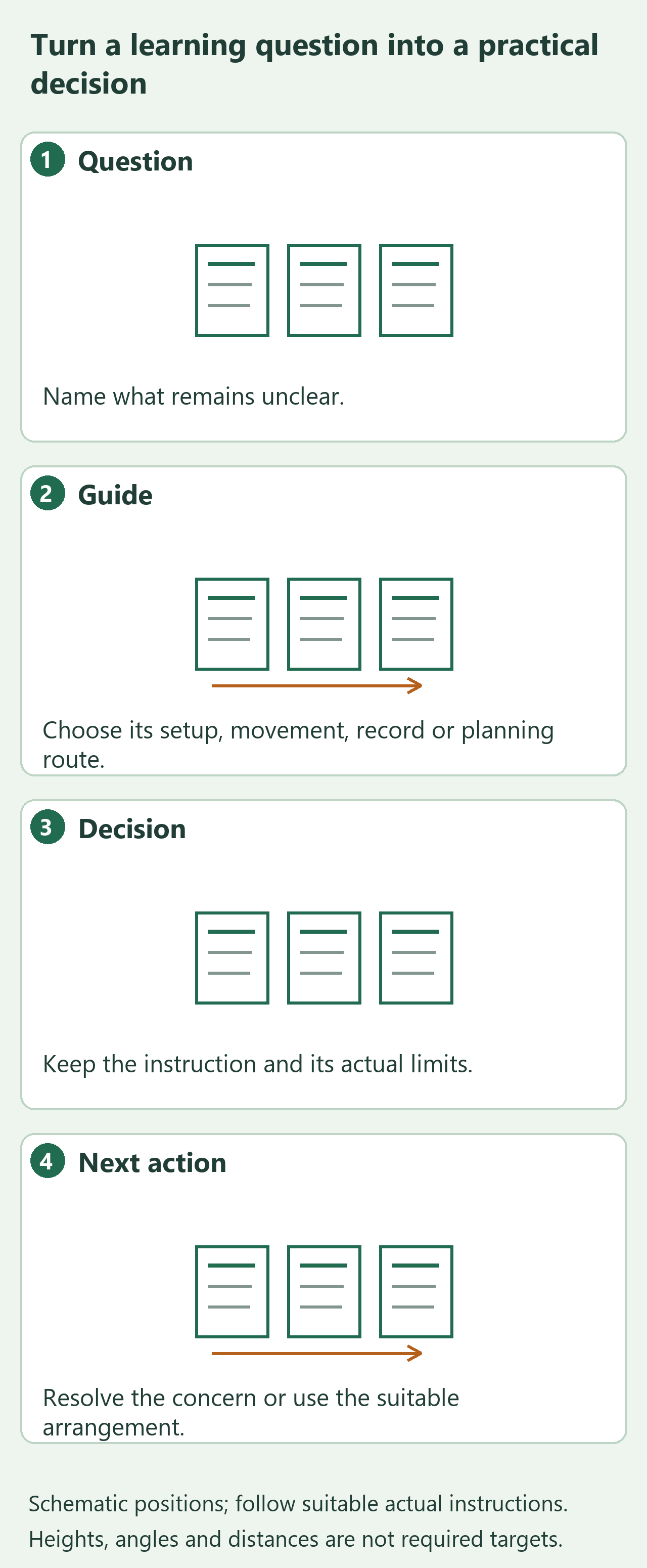
Start with the question you need answered
Learning about home workouts becomes more useful when it leads to a concrete decision. “How should I use this chair?” asks for a different guide from “How did I count this set?” or “What should change next week?” Name that question before choosing a session.
This learning page groups the site's practical material by setup, movement, records and planning. The examples and worksheets support general adult exercise education. They cannot inspect your equipment or technique, choose an individualized rehabilitation plan or diagnose a symptom.
First: establish the room and support
Use room layout for the station, storage and shared access, then the movement-clearance checklist for actual travel and transitions. Include the way into and out of a floor position, not only the position itself.
For furniture, distinguish its job with the chair and bench comparison. Use the chair-selection worksheet for the exact item, fit, condition and instructions. Sitting, light hand contact and body-weight pressing do not ask the support to do the same thing.
For pressing, use the wall, counter and floor comparison and the fixed-counter movement guide. The floor is not a required destination. An unsuitable fixture does not become suitable because its height looks like the next level.
For bands, start with inspection, compatibility and matching instructions. Resolve the equipment question before trying a movement. The band, handle, anchor and chosen setting are connected parts of the actual arrangement.
Next: understand one movement's start and return
An exercise description should tell you the version, starting position, motion and return, along with relevant setup and control points. A single cue is useful within those instructions; it does not replace them or certify suitability after two repetitions.
For chair work, distinguish a complete sit-to-stand cycle from a chair-touch squat. If a seated lifting task is unclear, read the seated knee-lift comparison before treating a floor crunch or leaning-back movement as equivalent.
For bodyweight control, read the separate squat, glute-bridge and bird-dog instructions. Their support arrangements and movement phases differ. Do not use another exercise's range or counting convention without identifying the change.
Keep records understandable before comparing numbers
The bodyweight log explains version, range, named tempo phases and repetition units. “Eight bird-dogs” is ambiguous until you know whether it means eight single-side cycles or eight left-and-right pairs. A changed range also changes what a count can show.
The cardio response guide serves another task: describing a suitable standing interval, its actual work and rest, and effort observed during the movement. A fluent sentence after a long rest cannot recover a talk test you did not assess during work.
Keep a planned amount separate from what happened. An interrupted repetition, an early rest or an unknown timing belongs in the note. You do not need to make the result match the page to learn something useful from it.
Use the right planning guide for the next decision
Read progression without rushing when you need to decide whether to repeat, reduce, rest or consider one appropriate change. A higher count is an observation under its recorded conditions, rather than proof of readiness for every harder variation.
Use a calendar when the practical problem is keeping suitable sessions in a workable week. The three-week chair plan and six-week bodyweight plan provide illustrative structures. Their week numbers are planning labels, not deadlines for adding load or removing support.
For a single written session, the chair-supported example organizes chair and seated tasks. The dumbbell tempo example needs the selected movements, equipment and phase key understood first. A headline duration does not dictate your starting amount.
Use this guide map
On a narrow screen, scroll this table sideways to read all columns.
| Task | Choose a guide that gives you | Keep separate |
|---|---|---|
| Arrange | A station, object destinations, access and movement-path questions. | Room tidiness and exercise suitability. |
| Select support | The actual furniture or equipment role and matching requirements. | Appearance and approval for a different use. |
| Learn motion | The starting version, controlled movement and return. | A brief practice and a universal qualification test. |
| Record | Observed units, changed conditions and unknown details. | Planned targets and measured results. |
| Plan | A realistic next action and a change you can understand. | Calendar week numbers and automatic progression. |
Use sources for their actual instructions
NHS's strength and sitting pages describe particular chair exercises and gradual build-up. ACE's movement library describes specific movement phases and control points. The source links in each guide identify what informs it; they do not mean those organizations prescribed the site's original session timings, diagrams or calendars.
NHS's published standing warm-up is one concrete preparation routine, with a stated duration of at least six minutes and longer when needed. Its accompanying safety advice also gives general-exercise boundaries.
Follow relevant individual professional guidance when needed. NHS advises getting healthcare guidance when suitability or relevant health circumstances are uncertain and stopping immediately for pain or becoming unwell. A checklist, a talk test or a comfortable moment cannot clear a medical concern.
Finish learning with a small usable note
Write the question, the guide used and the decision you can now make. For example: “The chair is for sitting, not pressing; use its seated-fit and condition check, and leave the pressing block out until a suitable support is established.” That gives the next session a concrete starting point.
If a question remains unresolved, keep it visible. A missing manufacturer instruction calls for that instruction, rather than another workout link. An uncertain count calls for a clear unit, rather than more repetitions. Choose the next action that answers the actual question.
Keep detailed personal health information in your own notes. The worksheets can be downloaded and used locally; you do not need to send a record to this website to use the learning method.
Turn a learning question into a practical decision
Examples to work through
These fictional examples illustrate practical choices and observations.
The support question comes before the workout
Emi learns that her session mixes sitting with pressing. She identifies the separate support roles and resolves each intended setup before choosing the amount. Another longer session would not answer the furniture question.
The repetition unit changes
Luis’s two bird-dog notes use single-side and paired cycles. He opens the recordkeeping guide and keeps the count definitions visible. The larger number alone cannot establish a larger amount of equivalent work.
A calendar becomes a deadline
Rae thinks the next numbered week requires a harder movement. She uses the planning guide to decide whether repeating or revising the suitable arrangement makes more sense. The calendar label does not remove a support need or a recovery concern.
A symptom is treated as a guide-selection problem
Sam feels pain and starts looking for a gentler variation. He stops exercise and seeks appropriate help instead. Source safety advice calls for a symptom response; another movement page cannot diagnose or clear the concern.
Home-workout question and learning note
Use these optional reminders to mark fields you want to keep in your own notes. The downloadable blank sheet contains every record field. Keep your completed record in your own appropriate private place.
Frequently asked questions
Do I need to read every guide before exercising?
Choose the guide that resolves the actual unanswered question, while following suitable exercise and equipment instructions. A room question, support question and unclear movement may need separate answers. This page is a map, not a compulsory reading course.
Do the sources endorse these workout calendars?
The sources inform specific movement, setup and general exercise guidance. The site's diagrams, records and session calendars are original educational arrangements. They are not presented as NHS- or ACE-prescribed programmes or individualized exercise advice.
How do I decide whether to log or progress?
First make the record understandable: version, conditions, units and actual result. Then consider an appropriate next decision using the progression guide. A clear note can support that decision without measuring strength or certifying readiness.
Must I send a worksheet to the website?
No. Download it and keep your own practical notes locally. Record only what is useful to you, and keep personal health details in your own records. The site does not need a submitted worksheet for you to use the guides.
Sources and what they support
- NHS: Strength exercises
Stable chair and seated fit; sit-to-stand, supported calf raise and wall press-up descriptions, example counts and gradual build-up.
- NHS: Sitting exercises
Stable chair, seated fit and the upright single-leg hip march. Use its own movement instructions and suitability guidance.
- NHS: How to warm up before exercising
The specific standing warm-up takes at least six minutes and can be longer. The accompanying general exercise advice includes stopping for pain or becoming unwell and obtaining appropriate guidance when suitability is uncertain.
- ACE Exercise Library: Bodyweight Squat
Standing setup, controlled hip and knee movement, foot and trunk control, comfortable range and standing return.
- ACE Exercise Library: Glute Bridge
The basic two-feet floor position, abdominal control, lifting without excessive back arch and controlled lowering.
- ACE Exercise Library: Bird Dog
Hands-and-knees setup, opposite-limb reach, back and hip control, and return to the starting position.
The diagrams, fictional cases, records and combined session calendars are original educational aids. The listed sources inform the specific guidance described above; they do not prescribe every example timing or assess your individual situation.