Six-Week Bodyweight Strength Plan: Sessions, Rest and Repeats
Revised · General adult exercise education
This calendar shows twelve practice opportunities across six weeks using a small set of bodyweight movements. The example counts and session timing make it concrete; they remain adjustable. Progression means choosing an appropriate next practice from actual observations, not automatically increasing every week.
What this calendar does and does not cover
This plan organizes a small set of basic strength-practice movements: a bodyweight squat, wall press-up, two-feet glute bridge and bird dog.
ACE supports the squat, bridge and bird dog descriptions; NHS supports its wall press-up and separate preparation guidance. The six-week calendar, worked counts and combined session clock are original examples. They are not source-prescribed programs.
This limited selection is not a complete plan for every muscle group, an individual fitness assessment or rehabilitation. Use only appropriate familiar movements, floor transitions and preparation under relevant guidance. If a task is not suitable, revise the actual session rather than assuming the calendar establishes suitability.
Two clearly defined sessions
On a narrow screen, scroll this table sideways to read all columns.
| Session | Movement order | Worked short-practice example |
|---|---|---|
| A | Bodyweight squat → wall press-up → basic two-feet bridge. | One short set of 3 completed cycles per task, if appropriate, with the needed rest. |
| B | Bodyweight squat → wall press-up → opposite-limb bird dog. | One short set of 3 squat and 3 wall-press cycles; 2 bird-dog cycles per side, if appropriate. |
The numbers above are illustrative learning counts, not universal starting doses or qualification tests. Use less, omit a task or follow your individually instructed amount when needed. More repetitions are not required to make a practice useful.
For squat, bridge and wall press, a cycle includes the controlled outward phase and return to the start. For bird dog, record right-arm/left-leg and left-arm/right-leg reach-and-return cycles separately. Two each side is four total cycles.
Keep the movement versions recognizable
Bodyweight squat: start standing with suitable foot contact, move the hips back and down with controlled trunk and knee direction, then rise smoothly within a comfortable range. No required parallel depth or slow-tempo target is added here.
Wall press-up: NHS describes standing at arm's length with hands at chest height, slowly bending the elbows toward the wall and pushing back with control. Establish a suitable wall and contact position; a chair or movable object is not a substitute wall.
Basic bridge: lie with knees bent and both feet flat, lift the hips without forcing height or excessively arching the lower back, then lower under control. Keep this two-feet version separate from marching or single-leg tasks.
Bird dog: begin hands below shoulders and knees below hips, reach opposite limbs while maintaining back and hip control, then return before the other side. Limb height is not a score.
An illustrative session clock with rest included
On a narrow screen, scroll this table sideways to read all columns.
| Phase | Example allocation | What belongs inside |
|---|---|---|
| Suitable preparation | 6 minutes. | Follow appropriate preparation instructions; allow longer when needed. |
| Setup and transition check | 3 minutes. | Confirm wall, floor, device position and suitable transitions. |
| First movement opportunity | 4 minutes. | Appropriate brief practice and rest, not continuous repetitions. |
| Second movement opportunity | 4 minutes. | Transition, suitable brief practice and needed rest. |
| Third movement opportunity | 4 minutes. | Suitable floor transition, brief practice and rest. |
| Finish | 5 minutes. | Unhurried suitable recovery, record and room reset. |
This example is 6 + 3 + 4 + 4 + 4 + 5 = 26 minutes, including transitions and rests. Complete room and product checks beforehand when they need more time, and include that real time separately in the record.
NHS's specific standing warm-up takes at least six minutes and can be longer. The allocation above does not approve every preparation or replace individual instructions. Extend the actual session or omit a task instead of rushing a transition or reducing needed rest.
All six weeks and twelve opportunities
Monday and Thursday are example diary slots, not mandatory spacing. Change the days, repeat a week, leave a slot unused or revise the practice under relevant guidance. Neither two completed sessions nor a week number certifies readiness for an increase.
On a narrow screen, scroll this table sideways to read all columns.
| Week | First opportunity | Second opportunity | Review focus |
|---|---|---|---|
| 1 | Monday: Session A, suitable worked version or revision. | Thursday: Session B, suitable worked version or revision. | Setup, movement names, floor transitions and actual counting units. |
| 2 | Monday: A, retain an appropriate recognizable version. | Thursday: B, retain an appropriate recognizable version. | Controlled returns, actual rests and any changed contact or support. |
| 3 | Monday: A, repeat or follow one appropriate named change. | Thursday: B, repeat or follow one appropriate named change. | Keep amount, range and tempo changes separate. |
| 4 | Monday: A, keep or revise the actual Week 3 version. | Thursday: B, keep or revise the actual Week 3 version. | Describe whether the changed version remains appropriate. |
| 5 | Monday: A, repeat, reduce, omit or rest as needed. | Thursday: B, repeat, reduce, omit or rest as needed. | Review comfort, recovery and changed diary or room conditions. |
| 6 | Monday: A, use the recognizable appropriate practice. | Thursday: B, use the recognizable appropriate practice. | Summarize the version to retain and the next question to resolve. |
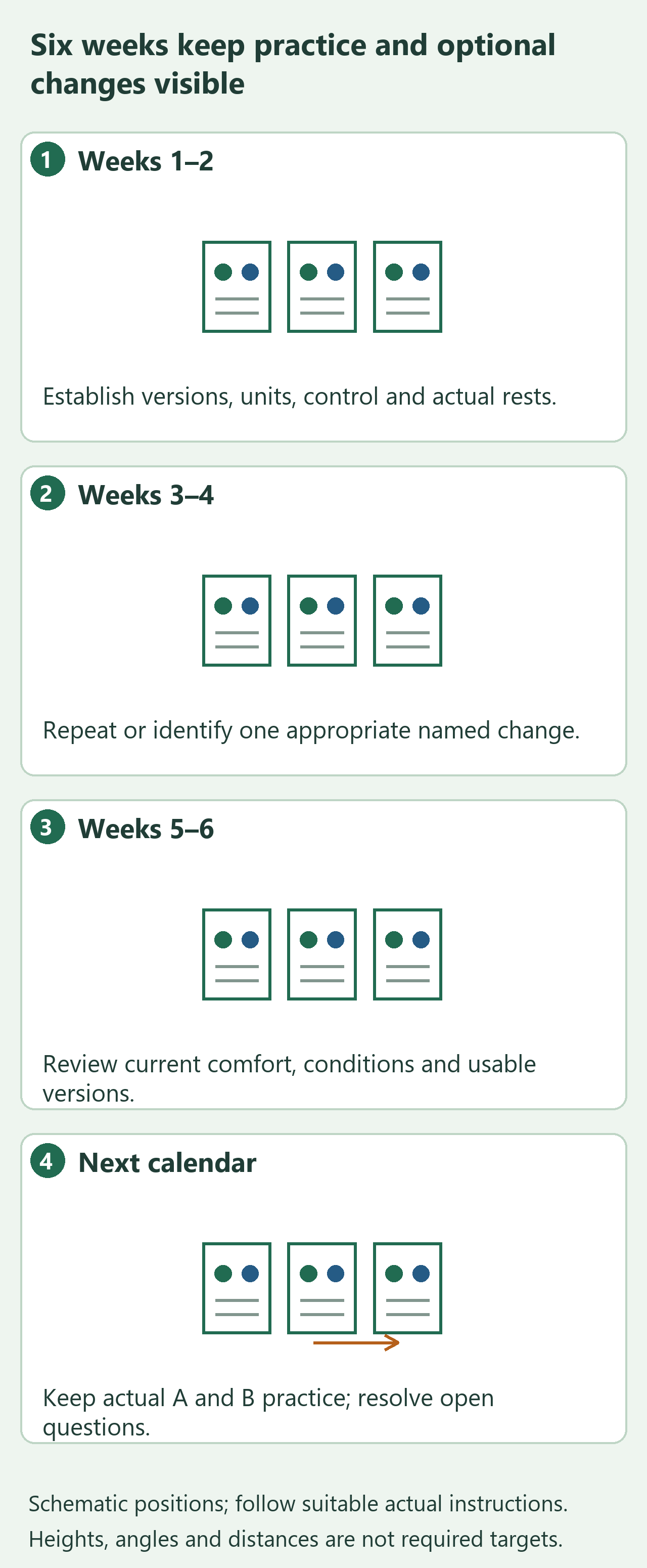
Weeks 1–2: make the starting point real
Keep the actual versions, completed cycles, side counts, rest and elapsed time clear. If you cannot use a floor task or wall contact appropriately, record the omission and resolve the question. A smaller revised session is more informative than a completion tick that hides a different movement.
Look at the return phase as well as the outward phase. A squat with a rushed rise, a bridge that becomes a hold or bird-dog reaches without returns changes the counting unit or task. Preserve that observation before comparing totals.
Weeks 3–4: make any appropriate change identifiable
Repeating is allowed. If a change is appropriate under your relevant guidance, name one factor: amount, comfortable range, a described timing intention or the particular instructed version. Do not increase count, deepen range and shorten rest together and then call the sessions identical.
For example, a record can say “same squat version and range; one additional completed cycle under appropriate guidance; rest unchanged.” That is an example of clear labeling, not a recommendation that every reader should add one cycle.
Weeks 5–6: review the whole practice, not just the number
Consider whether the version, setup and actual amount remain appropriate in your current situation. Repeating, reducing, omitting a task, resting or seeking instruction are possible next actions. Do not catch up missed sessions by doubling a later slot.
At the final review, keep a short description of the actual A and B versions worth retaining. A six-week completion is not a guarantee of a strength gain or permission for a loaded, single-leg or harder floor exercise.
Stop immediately if pain occurs or you become unwell, consistent with NHS's exercise safety advice, and obtain appropriate guidance for symptoms or uncertainty. Use the progression guide for decisions and the record guide for units.
Six weeks keep practice and optional changes visible
Examples to work through
These fictional examples illustrate practical choices and observations.
You cannot use the bridge floor transition
Revise Session A and record the omitted task. Resolve a suitable movement and transition under appropriate guidance; a thicker mat or nearby chair does not establish a transfer method.
Week 3 uses the same counts as Week 1
That can be a valid recognizable practice. Use the records to review setup, control, comfort and rest rather than assuming that a new week requires a bigger number.
One change makes comparisons unclear
Name the changed factor and keep the others visible. If you altered range, count and rest together, describe the session as changed instead of treating the larger total as a direct improvement.
Week 5 has a missed diary slot
Leave the unused slot in the record and resume appropriate practice. Adjust days or repeat the week rather than doubling a later session to match the calendar.
Six-week A/B practice calendar and revision record
Use these optional reminders to mark fields you want to keep in your own notes. The downloadable blank sheet contains every record field. Keep your completed record in your own appropriate private place.
Frequently asked questions
Which movements are in Sessions A and B?
Both use a bodyweight squat and wall press-up. Session A then uses a basic two-feet bridge; Session B uses opposite-limb bird dog. Use the appropriate versions and record omitted or revised tasks.
Are the example counts prescribed by ACE or NHS?
No. The short worked counts and combined calendar are original examples. Sources support the named movement descriptions and separate preparation guidance, not this entire program.
Must I progress every week?
No. Repeat, revise, reduce, omit or rest under appropriate guidance. If you make a suitable change, name one factor rather than assuming readiness from the calendar.
Is this a complete whole-body strength program?
It organizes a limited set of basic movements and does not cover every muscle group or individual need. Use appropriate guidance for a complete training plan.
Sources and what they support
- ACE Exercise Library: Bodyweight Squat
Standing setup, controlled hip and knee movement, foot and trunk control, comfortable range and standing return.
- ACE Exercise Library: Glute Bridge
The basic two-feet floor position, abdominal control, lifting without excessive back arch and controlled lowering.
- ACE Exercise Library: Bird Dog
Hands-and-knees setup, opposite-limb reach, back and hip control, and return to the starting position.
- NHS: Strength exercises
Stable chair and seated fit; sit-to-stand, supported calf raise and wall press-up descriptions, example counts and gradual build-up.
- NHS: How to warm up before exercising
The specific standing warm-up takes at least six minutes and can be longer. The accompanying general exercise advice includes stopping for pain or becoming unwell and obtaining appropriate guidance when suitability is uncertain.
The diagrams, fictional cases, records and combined session calendars are original educational aids. The listed sources inform the specific guidance described above; they do not prescribe every example timing or assess your individual situation.