Practical guide
Resistance Band Inspection: Wear, Anchors and Instructions
Check the whole band setup before adding tension: identify the product, inspect its connected parts and match the anchor to its own instructions. Visible damage, unresolved attachments and an applicable recall need action before exercise. An original inspection map, two comparison tables and eight explained cases help you record the concern and choose the next step.
Identify the band and find its own instructions
Start with the equipment you actually have: a flat strip, a closed loop, a tube with fixed handles, or a tube that clips to separate accessories. Write down the brand and model, and keep the matching instructions available. A color or a resistance number is not enough to identify every connection or permitted anchor.
For a set with interchangeable pieces, identify the handles, straps and anchors as well as the elastic. Check whether they belong to that system and whether the manufacturer permits the combination. A borrowed accessory that appears to fit still needs a matching instruction.
This guide helps generally healthy adults organize a pre-use equipment check. Its manufacturer examples come from the currently linked Bodylastics manual. They explain why specific instructions matter; they do not approve other products or assess whether an exercise suits your health. If the equipment or instructions remain uncertain, leave that setup out while you resolve the question.
Keep product safety separate from appearance. Where a recall may apply, check the exact model and markings against the manufacturer or the relevant consumer-safety authority. The CPSC recall directory is a U.S. resource; use the appropriate authority for your location. One search or one dated example is not a clearance of every band you own.
Use an inspection map before adding tension
The original map below organizes the check into identity, condition and setup. Jump to the inspection map. Read its stop point before preparing a workout: an unresolved concern does not become acceptable because the planned set is short.
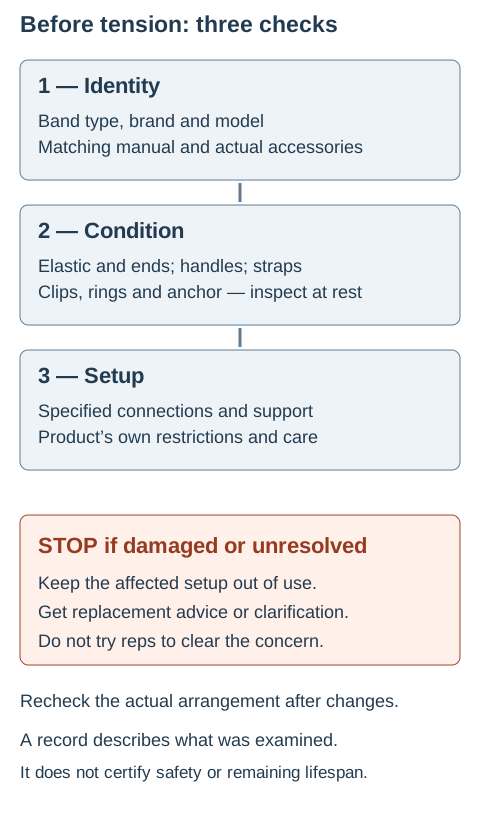
Inspect accessible components without placing exercise tension on a questionable band or anchor. Look at both ends and the parts used to attach the band, not only the length of elastic between them. Follow any additional inspection method in the product’s instructions; this article does not introduce a force test, disassembly procedure or way to prove a hidden connection sound.
Write the actual observation: “fraying visible at the anchor strap” or “attachment method not identified.” That is more useful than “band passed.” The next action follows the concern—replacement advice, matching instructions or a different suitable setup.
Check the whole set, not just the elastic
Bodylastics’ safety page calls for inspecting bands, handles, straps, anchors and any bar before each use. It tells users to stop immediately if anything looks damaged. Apply the actual product’s directions to the parts in your arrangement, including optional accessories.
| Part | Look at | Concern | Next action |
|---|---|---|---|
| Elastic band or tube | Its accessible length, ends and attachment areas. | Any visible damage or an unexplained change in condition. | Stop using the affected equipment; ask its manufacturer about replacement. |
| Handles and their connections | Handle body, straps and the band-to-handle connection. | Damage, an insecure connection or a connection you cannot identify. | Do not use a workout repetition to settle the uncertainty. |
| Straps and fastenings | Accessible webbing, stitching, closure and any metal ring. | Damage or a closure that cannot be secured as instructed. | Leave that accessory out until its condition and use are resolved. |
| Clips and rings | The actual pieces specified for this band and accessory. | Damaged parts or uncertainty about which piece receives the clip. | Check the exact instructions; a clip fitting physically is insufficient. |
| Anchor and its setting | Anchor material and the specified door or stationary support arrangement. | Damage or inability to satisfy the product’s stated setup requirements. | Choose a suitable alternative or pause instead of improvising an attachment. |
Visible cuts, tears, fraying or damaged fittings are concerns to stop and resolve. An unfamiliar change should be recorded rather than explained away because the equipment still stretches. If you cannot tell whether a change is damage, ask the manufacturer instead of using a loaded movement to decide.
Do not hide a problem with tape or an improvised knot and label the equipment repaired. Use the manufacturer’s replacement or service process. Keep the affected piece out of use while its condition is unresolved, so the next session does not start with someone finding it mixed into the usable set.
Match the actual anchor and connection method
Find the instructions for the chosen attachment. Check what receives the band: a fabric loop, a designated metal ring, an integrated connector or something else. Identify the support arrangement too. A product describing a door anchor does not approve every door, and a stationary object being nearby does not establish that it is suitable.
| Field | What to find | What does not settle it |
|---|---|---|
| Product identity | Brand, model and the components actually supplied. | A similar color or the same advertised resistance. |
| Connection method | Which ring, loop or attachment point receives this particular band. | “Clip it anywhere it fits.” |
| Anchor setting | Permitted support, door placement and any closure, gap or locking requirement. | An ordinary door or piece of furniture merely being available. |
| Use and extension limits | The actual model’s instructions, including how any limit is defined. | A stretch ratio or load number from another product. |
| Care and replacement | The manufacturer’s storage, inspection and replacement directions. | An invented universal lifespan or a repair with tape. |
The reviewed Bodylastics manual gives useful examples of these distinctions. Its safety page says to use the hinge side and lock the door; its door-setup page also specifies the hinge side. Its attachment pages show clips on designated metal rings, while its care page says to thread the band through an anchor loop instead of clipping to that fabric loop.
The same manual describes a D-ring option on its Anywhere Anchor. A metal D-ring and a fabric anchor loop are different features. Read the instructions for the exact accessory and configuration rather than combining a sentence from one setup with a picture of another.
The manual also gives position-specific door information and an extension restriction. Keep those instructions with that product. Do not borrow a numerical stretch ratio for a different band, assume a range of wording gives one precise universal limit, or test an uncertain door gap under load. If the text, picture or chosen arrangement seems inconsistent, get clarification from the manufacturer before using it.
Know when to stop using the equipment
Stop and resolve visible damage, a connection that cannot be secured as instructed, missing or incompatible parts, an unsuitable anchor setting, or a recall that identifies the affected product. If a necessary instruction is unavailable or unclear, pause that setup. Fewer repetitions and lighter effort do not answer an equipment-identification or attachment question.
Protective features have limits. The Bodylastics manual describes an internal safety cord, but explicitly states that no resistance band is snap proof, including its own. It also says the band will not catch you if it breaks. Do not rely on elastic tension to hold your balance; follow the product’s position and balance instructions and use an exercise suitable for you.
A concrete recall example shows why all of this is more than an elastic-surface check. The CPSC’s May 21, 2026 HomeProGym notice describes certain bands forcefully separating from their handles. It identifies specific purple 60-pound and gray 70-pound bands, with brand and resistance markings on their straps. The affected pieces require the notice’s action even if they look new.
Read the complete notice to identify the affected product and current remedy. Do not generalize the example to every band of the same color or destroy unrelated equipment. If you cannot establish whether your product matches, seek clarification from the manufacturer or appropriate authority rather than training with it while guessing.
Use care instructions and recheck after changes
Storage and handling are part of the product instructions. For its bands, Bodylastics says to avoid direct sunlight and extreme heat or cold, not wrap the elastic directly around stationary objects, and not pull it side to side through an anchor like a pulley. These are directions for that system; consult your own product for its care and permitted attachments.
Do not invent a universal replacement date. Condition, history and the manufacturer’s instructions matter, and an age estimate does not cancel visible damage or an applicable recall. A record can remind you when a concern was found; it cannot predict the remaining life of the material.
Recheck when you change a handle, anchor, band or support arrangement. A sound-looking component still needs compatibility and correct attachment in the new combination. If the set is shared, communicate the unresolved concern and keep the affected piece out of the next person’s setup.
Room clearance remains a separate decision. Use the movement-clearance checklist to consider the actual movement, transitions and access route. A clear room does not resolve a damaged band, and a checked band does not establish that the selected movement fits the room.
Practice eight pre-use equipment decisions
These original cases give only the conditions stated. Choose an action, explain why, then open the answer. The recalled-product example uses a real dated notice; the situations are teaching exercises, not reports of inspected equipment or certified setups.
Case 1
A tube has a visible cut near an end. It still feels springy. Should you try two easy repetitions to see whether it holds?
Show answer and explanation for case 1
No. Stop using the damaged equipment.
A workout repetition is not a way to clear visible damage. Bodylastics instructs users to inspect the whole set before each use and stop immediately if anything looks damaged. Follow the affected product’s replacement directions. Feeling elastic does not establish the integrity of the cut area, and reducing repetitions does not repair it.
Case 2
The elastic looks unchanged, but an anchor strap is fraying. Can you count the set as checked because you inspected the band?
Show answer and explanation for case 2
No. The anchor is part of the equipment check.
The load passes through more than the elastic. The manufacturer’s check includes handles, straps and anchors as well as bands. Leave the damaged accessory out and resolve replacement and compatibility before use. Inspecting one part cannot establish the condition of the connected system.
Case 3
A borrowed tube has no identifiable brand or instructions. A video for a similar-looking set shows a door setup. Is that enough to choose its anchor?
Show answer and explanation for case 3
No. Identify the equipment and obtain instructions for that product.
Similar appearance does not establish the permitted attachment, door placement or extension limit. Avoid putting tension on an uncertain setup to investigate it. Ask the owner or manufacturer for the product identity and matching instructions, or choose a suitable activity that does not require the unresolved equipment.
Case 4
A Bodylastics clip can physically fit over the fabric loop of its door anchor. Does physical fit override the manual’s instruction to thread the band through that loop?
Show answer and explanation for case 4
No. Use the specified connection rather than the convenient one.
The reviewed manual distinguishes clipping to designated metal rings from threading through an anchor loop. Page 12 explicitly says not to clip a band to an anchor loop. Page 10 separately describes the Anywhere Anchor’s D-ring option. These are different attachment features; a clip fitting over fabric does not make that arrangement approved.
Case 5
An anchor’s instructions require a locked door, but the chosen door cannot be locked. Does a light first set resolve the missing requirement?
Show answer and explanation for case 5
No. Resolve the anchor setting before applying exercise tension.
A lighter set does not satisfy a stated closure or locking instruction. Select a suitable arrangement allowed by the actual product instructions, use a suitable alternative, or pause. For the reviewed Bodylastics system, the safety page specifies the hinge side and a locked door. Do not turn that product-specific direction into a universal rule for every anchor.
Case 6
A band contains an internal safety cord. Can you skip inspection because the cord makes the band snap proof?
Show answer and explanation for case 6
No. The reviewed manufacturer explicitly says its bands are not snap proof.
Bodylastics describes an internal cord but also says no resistance band, including its own, is snap proof and the band will not catch you if it breaks. Keep the pre-use check and the product’s position and balance requirements. A protective feature does not remove the other instructions or prove the current condition of the set.
Case 7
A band looks unused, but its brand, strap markings and resistance match the specific HomeProGym bands in the May 21, 2026 CPSC recall. Does the absence of visible wear cancel the recall?
Show answer and explanation for case 7
No. Stop using the affected band and follow the exact recall notice.
The cited notice identifies specific purple 60-pound and gray 70-pound HomeProGym bands and a handle-separation hazard. A recalled product does not become cleared by looking new. Check the complete identification and remedy in the original notice. The notice does not mean that every purple band, every product from the brand or every band in a set is recalled.
Case 8
After checking a set, you change the anchor and add a different handle. Is the earlier record sufficient for the changed connections?
Show answer and explanation for case 8
No. Recheck the components and instructions for the actual arrangement.
The earlier note described a different setup. Confirm the condition, compatibility and connection method of the pieces now being used. Record the change and any unresolved question. A dated checklist is a reminder of what was examined, not a certificate covering every later combination.
Keep a short product and setup record
Download the resistance-band inspection record (TXT). It contains two blank setup records, a five-part component log, the instruction fields and all eight cases with explanations. Keep the matching manufacturer instructions beside it.
Product, model and identifiable markings:
Manufacturer instructions and version or access date:
Band, handles, straps, clips and anchor in this arrangement:
Condition observed at each accessible part:
Connection and support requirements for this setup:
Recall identification question, if relevant:
Unresolved concern and the piece kept out of use:
Next action — replacement advice, clarification or suitable alternative:
What changed since the previous check:
Make the note specific enough to use next time. “Clip-to-loop method not confirmed; do not use this arrangement” explains what remains unresolved. A later answer should update the relevant field, rather than silently changing the whole record to “safe.”
When the equipment question is resolved, choose a familiar, suitable movement and follow its actual exercise guidance. This inspection record does not prescribe a workout, rehabilitation plan or load progression. Its useful result is a clear equipment decision and a record of the specific instructions supporting it.
Sources and further reading
- Bodylastics: currently linked User Manual, PDF pages 4–12Product-specific pre-use inspection, stopping for damage, balance, door and attachment instructions, and band care. The complete text and rendered pages 4–12 were reviewed. Other bands require their own instructions; no independent durability test or universal extension limit is claimed.
- U.S. CPSC: HomeProGym resistance-band recall, May 21, 2026A dated, product-specific example of handle-separation risk and identification of affected bands. Consult the complete notice for identification and remedy; this is not an exhaustive recall list or a statement that other products are cleared.