Small Room Workout Layout: Three Setups and a Storage Plan
Revised · General adult exercise education
Start with the room you can actually use. Keep the entrance and household route available, choose a station for the movements in your session, and put tools where they will not become obstacles. These three illustrative arrangements help you plan the furniture and storage; check the actual movement path separately before exercising.
Choose one station before moving the whole room
A useful small-room workout layout gives you a place to exercise, a way into and out of that place, and a place for everything you move. It also gives the room back to the household afterward. Begin with one familiar, suitable session rather than trying to fit a mat, chair, weights and every movement into the same corner.
Write the positions you will need: standing, sitting, hands and knees, or lying down. Add any change between those positions. A chair session may need no floor station; a floor session needs a practical way to get down and back up. That choice determines which furniture could stay and which movable objects need another home.
This guide concentrates on arrangement and storage. The separate movement-clearance checklist covers where your limbs travel, overhead obstacles, transitions and surface checks in detail. Use both tasks: a tidy layout is a starting arrangement, not confirmation that every exercise fits.
Draw the fixed features first
On a quick sketch, mark the doorway, the direction the door opens, the route people normally use, and furniture you cannot reasonably move. Include a low shelf, radiator, screen or other feature relevant to the selected position. You do not need a measured architectural drawing to notice that a stored dumbbell or charging cable is in the route.
Give the household route its own place in the plan. Do not move everything from the activity area into the doorway or the narrow gap someone needs to cross. An exercise area that requires another person to climb over your equipment is an arrangement to revise before starting.
Next, identify movable objects and their temporary destination. A light side table may have a sensible alternative position; a large cabinet may not. If moving something heavy is impractical or uncertain, use another suitable arrangement or space. Rearranging furniture should not become an improvised lifting challenge.
Finally, mark the device location and any lead. Place a timer or screen so you can see the instructions from the planned position without leaning through furniture or repeatedly crossing the activity area. Set it up before the first movement.
Compare these three small-room arrangements
The examples below describe layouts, not prescribed exercises or minimum room sizes. Select the one that matches familiar movements you can do appropriately. Each still needs its actual floor, support and movement path checked.
On a narrow screen, scroll this table sideways to read all columns.
| Illustrative arrangement | What stays in place | What to arrange before the session | What remains to check |
|---|---|---|---|
| Standing station | Large furniture remains; one suitable area is used for a familiar standing movement. | Move loose objects to an identified storage place. Position the screen outside the movement path. | Foot travel, arm travel, overhead features, stopping position and the household route. |
| Chair station | A suitable chair occupies one planned place, with the access route beside it available. | Remove nearby objects that interfere with sitting, standing or the actual seated movement. | Chair role and condition, seated fit, floor contact, hand contact and transitions. |
| Floor station | The mat or exercise surface occupies one area; storage is outside it. | Arrange a practical way into and out of the floor position. Keep any necessary support accessible. | The whole body path, mat movement or edges, floor transitions and access after standing up. |
A standing station is not automatically a smaller or easier version of every floor routine. A chair station is not permission to press against the chair or stand on its seat. If you change the exercise family, revisit the arrangement instead of assuming that the first sketch covers the new task.
Keep storage out of the exercise and access routes
Choose a storage position before putting down the first tool. Keep weights and other objects where they will not roll into a route or be left underfoot. Follow the equipment's own storage instructions. Do not balance heavy items on a shelf or place them where taking one out creates another handling problem.
For a band set, keep compatible parts identifiable and keep a damaged or unresolved piece out of the usable set. The band inspection guide explains why the elastic, handle and anchor are separate parts to check. A neat basket cannot establish that a borrowed attachment belongs to your system.
If you use a mat, identify where it will go afterward. During use, it must not become a sliding surface or raised-edge obstacle. Piling mats together is not a general solution for floor grip or sound. Resolve the actual surface issue rather than using storage or padding to hide it.
Keep tools not needed for this session stored. A layout for one familiar routine often becomes clearer when unused equipment is removed from the activity area. You do not need to display everything you own to make a small room function as an exercise space.
Check a chair by its actual job
For its chair-based routines, NHS strength guidance specifies a solid, stable chair without wheels that will not slip on its surface. It also describes seated foot and knee position. Those instructions concern the particular routines; they do not turn an ordinary chair into a bench, step platform or body-weight pressing support.
Use the chair-selection worksheet for the item and its instructions, and the chair and bench role comparison when a session mixes different kinds of support. A chair placed near a wall still needs suitable condition, contact and intended use.
Do not bounce, shove or lean hard into uncertain furniture as a strength test. Resolve the concern first. If the required setup cannot be established, leave that movement out or choose an appropriate alternative whose arrangement you understand.
Use a setup and reset sequence
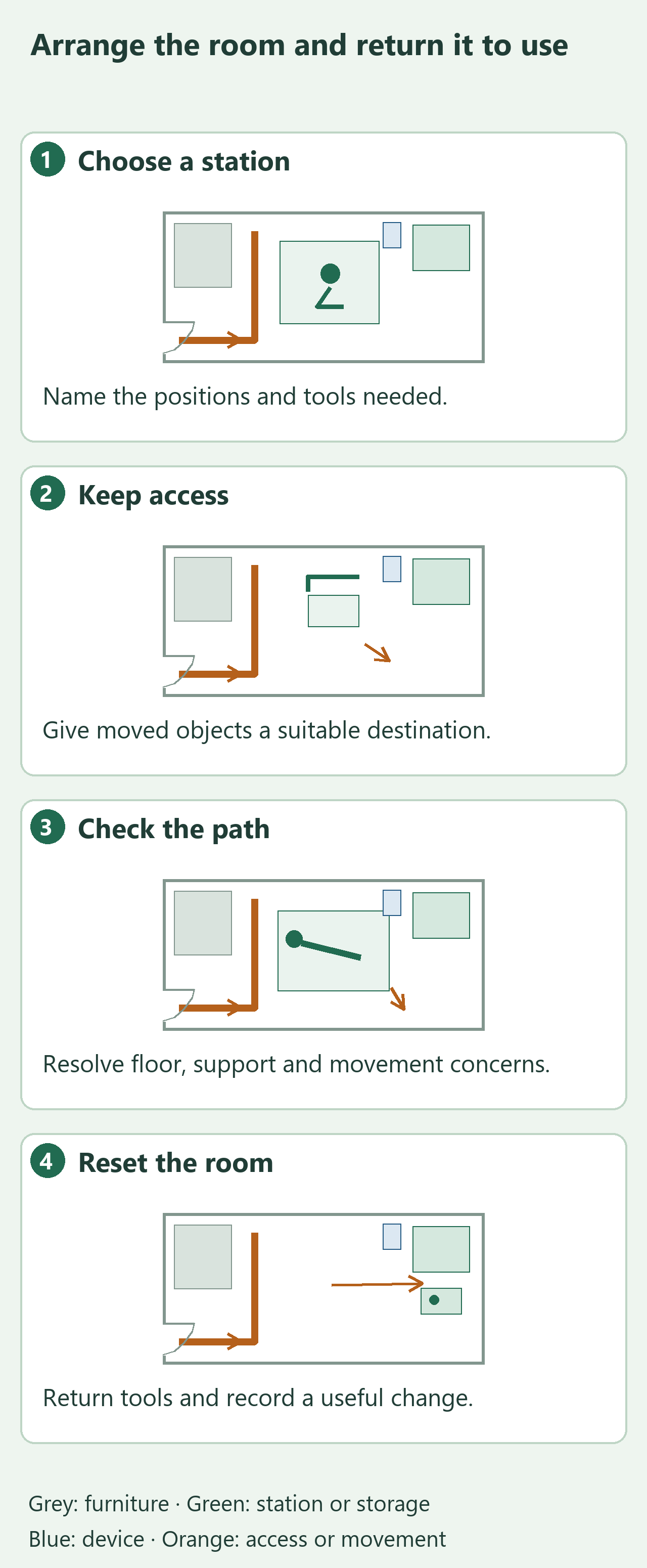
- Choose: name the session, its positions and the tools actually needed.
- Arrange: move the identified objects to their planned destination, leaving the doorway and household route available.
- Check: inspect the selected movement path, floor and supports; resolve relevant concerns before adding effort.
- Reset: return tools and movable objects to their intended places when the session ends.
For a shared room, agree how people and pets will remain clear while the session is happening. If someone needs to cross or an interruption changes the arrangement, pause and recheck before continuing. The plan should not depend on other people predicting the path of your next movement.
Keep the reset task modest and specific: mat to its storage place, weights to their intended location, side table returned, device lead put away. Record a change if the temporary destination caused another obstacle. That observation can improve the next layout without requiring a bigger workout.
Separate layout, time and sound decisions
If a table is in the movement path, a shorter timer does not move it. If a chair slips, slower repetitions do not establish its suitability. Resolve the obstacle or support question before choosing the amount of exercise.
If the layout is workable but the session is too long, choose a shorter suitable arrangement with its preparation and transitions included. If transmitted sound is the concern, use the quiet-apartment setup guide to consider the actual time, movement and setting. Neither change substitutes for a clear path or a suitable surface.
Room planning also cannot decide exercise suitability for your health. NHS's accompanying exercise-video safety advice says to get professional guidance when suitability or relevant health circumstances are uncertain, and to stop immediately for pain or becoming unwell. Keep that response separate from furniture adjustments.
Your useful result is a short layout note you can follow next time: which station, which objects move, where they go, which route stays available and what remains to check. Replace “room passed” with those concrete details.
Arrange the room and return it to use
Examples to work through
These fictional examples illustrate practical choices and observations.
The side table has nowhere suitable to go
Mina can move a side table out of the planned floor area only by blocking the doorway. She revises the arrangement or chooses another suitable space. Clearing one rectangle while obstructing the access route does not create a complete layout.
A standing session replaces a floor session
Jon chooses a familiar standing option instead of lying down in the planned area. He checks its foot and arm travel and the place to stop. He does not treat the earlier mat sketch as confirmation of the new movement path.
Unused weights remain beside the chair
Leah selects a seated session but leaves weights near the place she needs to stand up. She stores the unused tools appropriately before beginning. The tools are not part of this session, and their presence creates an avoidable obstacle.
An interruption changes the room
A household member moves an object during Arun’s session. Arun pauses and rechecks the relevant arrangement before resuming. A useful repeatable plan includes responding to a changed setting rather than defending the original sketch.
Small-room station and storage plan
Use these optional reminders to mark fields you want to keep in your own notes. The downloadable blank sheet contains every record field. Keep your completed record in your own appropriate private place.
Frequently asked questions
How large does a small-room workout area need to be?
There is no single dimension in this guide. Use the positions, limb travel, transitions and access needed by your selected familiar movements. A mat fitting is only one part of the arrangement; check the actual movement footprint separately.
Should I move a heavy sofa to make more space?
Use an arrangement you can establish appropriately. If moving a heavy item is impractical or uncertain, choose another suitable station or space. Do not make furniture handling an improvised exercise or block another route with the moved item.
Can I keep my chair, mat and weights in one corner?
Storage and exercise use are separate tasks. Keep items in their intended storage positions when not needed, and arrange the selected session without rolling objects, obstructed transitions or access problems. A tidy corner does not establish chair or equipment suitability.
Will this layout make a workout quiet?
The layout does not measure transmitted sound. Check the actual movement and shared setting separately, including suitable timing. A clear path can still contain an audible movement, and a quiet movement can still need substantial room.
Sources and what they support
- NHS: Strength exercises
Stable chair and seated fit; sit-to-stand, supported calf raise and wall press-up descriptions, example counts and gradual build-up.
- NHS: Sitting exercises
Stable chair, seated fit and the upright single-leg hip march. Use its own movement instructions and suitability guidance.
- NHS: How to warm up before exercising
The specific standing warm-up takes at least six minutes and can be longer. The accompanying general exercise advice includes stopping for pain or becoming unwell and obtaining appropriate guidance when suitability is uncertain.
The diagrams, fictional cases, records and combined session calendars are original educational aids. The listed sources inform the specific guidance described above; they do not prescribe every example timing or assess your individual situation.