Practical guide
No-Jump Home Cardio: Space, Pacing and the Talk Test
Choose the movement by its actual space requirements, then judge the effort during the work rather than from the no-jump label. Use an original two-path sketch, five standing options, talk-test examples and a short response record to separate effort, sound, setup and stop decisions.
Separate jumping, effort and sound before choosing a session
No-jump home cardio uses movements without an airborne jumping phase. That can remove repeated jump landings, but it does not make every movement easy, silent or suitable for every person. A quick standing march can require substantial effort, and a side step can still be audible through a floor.
Make three separate decisions: can the selected movement fit the room with control; is the effort appropriate today; and does the sound fit the shared setting? A quieter movement is useful only if its space and effort also fit. A faster pace does not resolve an obstacle or a slippery surface.
This guide is for generally healthy adults using familiar, suitable standing movements. It is an original planning and observation aid, not a rehabilitation programme, a medical clearance test or a promise about fitness or weight change. If you are unsure about suitability, seek appropriate professional advice before trying a movement.
Choose a standing option by its actual movement path
Start with one or two familiar options rather than a long sequence that is difficult to remember. The descriptions below identify options and practical adjustments; they are not a personalised exercise prescription. NHS warm-up guidance includes marching, heel digs and knee lifts. That source does not prescribe this article’s cardio arrangement or establish that a particular movement gives the same intensity to everyone.
| Option | Recognisable movement | Space to inspect | An adjustment to consider |
|---|---|---|---|
| March in place | Alternate small, controlled steps in a familiar standing position; let the arms move comfortably. | Foot placement, arm travel and room to stop. | Reduce pace or arm movement; use a comfortable knee height. |
| Side step and return | Step to one side, bring the other foot toward it without jumping, then change direction. | Both sideways paths, the return and nearby furniture. | Use an appropriate smaller step only if it still fits comfortably; otherwise select another movement or space. |
| Alternating heel dig | Place one heel forward and return; alternate sides with a comfortable supporting-leg position. | Forward foot placement and balance during the return. | Keep the placement modest and familiar; do not reach into an obstacle. |
| Comfortable standing knee lift | Lift and lower alternate knees with a controlled standing posture. | Space in front, balance and any hand movement. | Lower the chosen lift or slow down; a high knee is not a requirement. |
| Step jack without a jump | Use a familiar stepping version rather than an airborne jumping jack. | Sideways foot travel and the arms, including overhead obstacles if arms rise. | Use comfortable lower arm travel or another suitable option; do not twist around furniture. |
“Low impact” describes a different concern from effort. Avoid forcing a high knee, large side step or overhead arm reach merely to make the movement look more like a video. If a comfortable, controlled version cannot fit, leave it out or use another suitable space. Reducing duration alone does not change where the foot or hand travels.
Compare in-place steps with sideways travel
The original floor sketches compare two movement paths. They show why an in-place option and a sideways option need separate checks. Neither sketch sets a minimum room size or certifies a room, floor or exercise as safe.
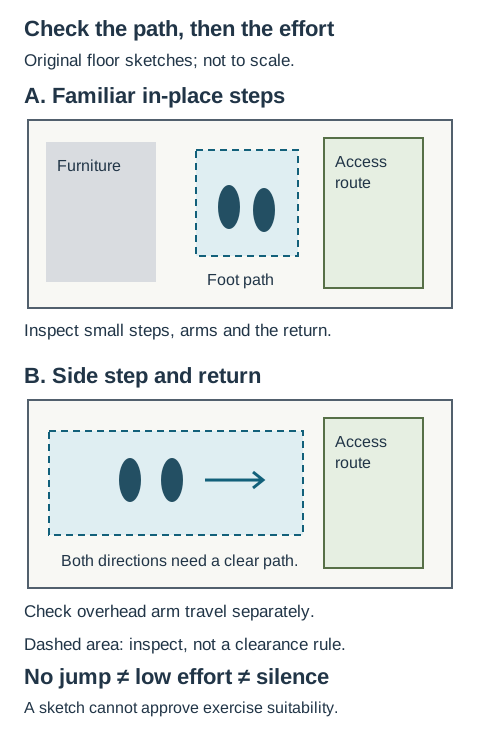
Download the two movement-path sketches. First inspect the floor for loose objects, cables, spills or mat edges. Include the return, a change of direction and the place you will stop. Keep the doorway and access route available; check upward arm travel separately from this floor view.
For a familiar movement, an easy walkthrough can reveal a path conflict after obvious hazards are resolved. It is not a test to complete on a doubtful surface or by leaning on uncertain furniture. Pause if the movement, floor or arrangement is uncertain. The broader small-apartment clearance checklist covers floor exercises, supports and transitions as well as standing work.
Use the talk test during the work, then record what it showed
CDC describes the talk test as a rule of thumb: during moderate aerobic activity a person can talk but not sing; during vigorous aerobic activity a person cannot say more than a few words without pausing for a breath. The observation belongs to the activity while it is happening. A fluent sentence after a long rest does not reconstruct the preceding interval’s intensity.
Use an ordinary, comfortable spoken sentence during a familiar, suitable movement when doing so does not distract you from control. Do not hold your breath or force a song to prove a category. If talking reveals more effort than you intended, slow the pace, simplify the arm movement or take a rest. Reassess a suitable adjusted version instead of trying to finish a target interval at any cost.
| Observation | Reasonable reading | What it cannot establish |
|---|---|---|
| Can talk but not sing during the movement | CDC’s rule of thumb for moderate aerobic intensity. | An exact heart-rate zone, calorie total or guarantee of exercise suitability. |
| Only a few words before a breath pause | CDC’s rule of thumb for vigorous aerobic intensity. | A target everyone should pursue, or evidence that a no-jump movement must be easy. |
| Talking feels easy; singing also seems easy | Describe the observation; the moderate talk-test cue has not been established. | A failed session. Light movement can be a reasonable starting choice. |
| Checked only after stopping | Record the rest observation separately. | The intensity of the work period that happened before the check. |
CDC also describes perceived effort on a 0–10 scale: 0 is the effort of sitting and 10 maximal effort; relatively moderate effort is about 5 or 6, with vigorous effort beginning around 7 or 8. These descriptions provide context, not a requirement to reach those numbers in a first home session. Record your own impression without inventing precision or treating it as a medical result.
If speech, communication or another circumstance makes the talk test unsuitable or hard to interpret, record “not assessed” and the relevant observation. Do not turn the missing check into a pass. Ask for appropriate advice if you need another way to judge suitable effort. There is no need to chase a score to make a short session count as worthwhile practice.
Change one pacing lever and keep rest visible
Begin gently with a familiar version. Pick a manageable work period and allow recovery; the purpose of this guide is to inspect the arrangement and response, not to set a universal work-to-rest ratio. A timer can prompt a check, but it cannot determine whether your effort, balance or breathing is suitable.
If the effort is more than intended, change a clear lever: slower steps, less arm movement, a comfortable smaller range, a shorter work period or more rest. Choose an adjustment that preserves control and actually addresses the concern. If a side step conflicts with furniture, changing the timer is insufficient; resolve the path or choose an appropriate option that fits.
Change one lever at a time when you want to understand its effect. Write the version and actual work and rest periods, including unplanned pauses. If you slow down halfway through, describe both parts rather than labelling the whole interval with the final pace. Keeping those changes visible makes the next session easier to compare.
No-jump movement also does not guarantee a quiet floor. Check the real setting respectfully and choose an appropriate time, location or lower-impact option if sound is a problem. A mat may change foot contact, but it is not a tested soundproofing solution and can itself slide or create an edge hazard. Do not add mats to an unresolved floor problem.
Allow a real warm-up instead of protecting the headline duration
NHS’s published warm-up routine says it should take at least six minutes and longer if needed. It includes marching, heel digs, knee lifts, shoulder rolls and knee bends. That is the timing of that specific source routine; it does not prove that every person or activity needs exactly six minutes, and this article does not reproduce its repetition targets as a cardio prescription.
Plan enough time to begin gently and follow suitable warm-up guidance. Do not compress a needed warm-up because an article title promises fourteen or twenty minutes. The site’s 14-minute standing cardio block example and 20-minute standing cardio block example are editorial arrangements, not NHS-endorsed programmes. Allow extra time or shorten suitable later work if your preparation needs longer; keep the actual total honest.
After appropriate work, ease the pace down when you are well enough to do so and record the response. Ordinary end-of-session downshifting is different from a symptom that requires stopping immediately. Do not continue moving as a cooldown requirement when you feel pain or become unwell.
Stop for pain or becoming unwell; treat missed targets separately
NHS exercise-video safety information says to stop immediately if you feel any pain or become unwell. It advises getting professional guidance before exercises when suitability is uncertain or relevant health circumstances apply, including an injury, symptoms, feeling unwell, a recent health event, pregnancy or recent childbirth.
Use that distinction in a home session. Losing control or discovering an unresolved space issue is a reason to pause the movement and resolve it. Pain or becoming unwell is a reason to stop, not to try a faster interval, a different knee height or another room as a remedy. Seek appropriate help for concerning or persistent symptoms; severe or urgent symptoms call for local emergency help.
A shorter-than-planned work period is an observation. It does not mean the session failed, and a missed warm-up is something to address before proceeding rather than a physiological stop signal. Do not restart automatically after symptoms disappear or use the talk test to decide that a health concern has cleared.
Six checks: choose the adjustment that addresses the concern
These are original fictional situations, not observed training results. Keep the movement path, effort observation, sound concern and symptom response distinct.
Case 1
You avoid jumping but can say only a few words before pausing for breath. Does the no-jump label establish moderate effort?
Show answer and explanation for case 1
No. Jumping and relative effort are separate observations.
CDC’s talk-test rule of thumb associates that speech pattern with vigorous aerobic intensity. It does not require you to maintain it. If it is more effort than intended, slow or simplify a suitable movement or rest, then reassess. Record the response during the work. If you feel pain or unwell, stop instead of treating a pace change as a remedy. The movement name alone cannot establish a suitable intensity.
Case 2
After resting, you can speak easily. You did not check speech during the preceding work. Can you label that interval moderate?
Show answer and explanation for case 2
No. Record that its work-period talk test was not assessed.
Recovery changes the situation. Easy speech after a pause describes the rest period, not the effort during the earlier movement. Keep the actual work duration, pause and any remembered observations, but leave the unmeasured talk-test result unknown. During a future suitable interval you can check comfortable speech without compromising movement control. Do not fill the gap with a plausible-sounding category.
Case 3
A side step approaches a table, but an in-place march fits a separate clear area. Will cutting the side-step interval in half solve the conflict?
Show answer and explanation for case 3
No. The adjustment must address the movement path.
A shorter interval still uses the same sideways path. Resolve the obstacle appropriately, select a familiar suitable option that genuinely fits, use another appropriate space or pause. Check the return, arm movement and route as well as the starting foot position. The in-place option needs its own floor and suitability checks; it is not approved merely because its footprint looks narrower in a sketch.
Case 4
Your steps are controlled and you can talk but not sing, yet someone downstairs hears the movement. Does the talk test settle the noise concern?
Show answer and explanation for case 4
No. Effort and sound need separate decisions.
The speech observation is consistent with CDC’s moderate-intensity rule of thumb, but it does not measure transmitted sound. Consider an appropriate time or location, or a suitable lower-impact option that respects the setting. Do not claim a mat guarantees silence or pile unstable surfaces together. Record which movement and setting caused the concern so a future adjustment responds to that actual issue.
Case 5
You feel pain during a familiar march but can still complete a sentence. Is passing the talk test a reason to finish the interval?
Show answer and explanation for case 5
No. Stop the exercise immediately.
NHS’s stop advice for pain or becoming unwell is separate from the talk test’s rough indication of aerobic effort. Speaking comfortably does not establish that a painful movement is safe or diagnose its cause. Do not change the pace or move to another room as a substitute for addressing the symptom. Seek appropriate help for concerning or persistent symptoms, and local emergency help for severe or urgent symptoms.
Case 6
You used more warm-up time and completed less main work than the written block example. What should the log show?
Show answer and explanation for case 6
Record the actual warm-up, work and rest, including the change.
Keep the headline duration separate from what happened. A longer appropriate warm-up is not evidence of failure, and shortening suitable later work can keep the session manageable without rushing preparation. Record the familiar movement version, the actual periods and the response during work. Compare a later session only with the differences visible. Do not invent a completed interval or a calorie result to make the record match the plan.
Keep a short version-and-response record
Download the editable space and response record. It contains two blank interval records, the movement options and all six worked explanations. Use a short description that you can recognise next time; no private health details need to be sent to this site.
- Movement and version: familiar march in place, comfortable knee height, small arm movement.
- Path check: floor, foot return, arms and access route checked; overhead reach not used.
- Actual work and rest: write what happened, including early pauses and changes.
- Talk test during work: record the words or breathing observation, or “not assessed.”
- Perceived effort: optional rough impression with the scale named; no invented measurement.
- Response and decision: pain or becoming unwell means stop; record any separate space or sound adjustment.
On another day, use the same movement description and keep differences in pace, arm travel, warm-up and rest visible. The bodyweight range and repetition log serves a different task when you want to count controlled repetitions. This cardio record describes an interval and its response; it does not turn a movement count into an intensity score.
Sources and further reading
- CDC: How to Measure Physical Activity IntensityTalk-test rule of thumb and the 0–10 perceived-effort context. These describe aerobic effort; they do not provide clinical clearance, calorie estimates or targets for everyone.
- NHS: How to warm up before exercisingNamed standing warm-up movements, the timing of this particular routine and when to stop or seek advice. The site’s cardio blocks are original examples; NHS does not prescribe them.