40-Minute Dumbbell Tempo Workout: Squat, Curl and Wall Press
Revised · General adult exercise education
This 40-minute example combines dumbbell goblet squats, hammer curls and a wall press-up block. Every phase, practice window and tempo key is defined. It is a limited lower-body and arm-focused practice with pressing, not a complete whole-body training plan.
What this session is for
This is a technique-focused example for familiar appropriate goblet squats, hammer curls and wall press-ups. It provides a readable clock and tempo notation, rather than treating “slow” as one instruction for every exercise.
ACE supports the goblet squat and hammer curl descriptions. NHS supports the wall press-up and separate preparation guidance. The combined clock, worked counts, tempo examples and number of opportunities are original arrangements, not source-prescribed doses.
Use suitable familiar weights and relevant instruction for your situation. This page does not choose your dumbbell load or establish medical readiness. It uses a suitable wall rather than an improvised chair bench and includes no floor exercise or floor transfer.
Read the tempo key before starting
The order on this page is lowering / pause in the lowered position / lifting or pushing return / reset. A zero means no added deliberate pause; it does not mean dropping or bouncing.
On a narrow screen, scroll this table sideways to read all columns.
| Movement | Illustrative tempo | Plain-language meaning |
|---|---|---|
| Goblet squat | 3–0–2–1 | About 3 seconds lowering, no added bottom pause, about 2 seconds rising, 1 second standing reset. |
| Hammer curl | 2–0–2–1 | About 2 seconds lowering the hands, no added bottom pause, about 2 seconds curling, 1 second reset at the raised position before lowering again. |
| Wall press-up | 2–0–2–1 | About 2 seconds moving toward the wall, no added near-wall pause, about 2 seconds pushing back, 1 second reset. |
The hammer curl begins with hands by the thighs, so its first action is the lifting phase even though the notation lists lowering first. Record that starting point rather than reading the digits as a command to lower from a position you have not reached.
These are optional illustrative timing intentions. Remove or revise them when appropriate rather than forcing a tempo that changes control, comfort or normal breathing. Do not claim each phase was precisely measured unless it was.
The complete 40-minute clock
On a narrow screen, scroll this table sideways to read all columns.
| Clock | Allocation | Actual contents |
|---|---|---|
| 0:00–6:00 | 6 minutes preparation. | Follow suitable preparation instructions and allow longer when needed. |
| 6:00–10:00 | 4 minutes setup. | Establish familiar weights, permitted grip, clear floor, suitable wall and device position. |
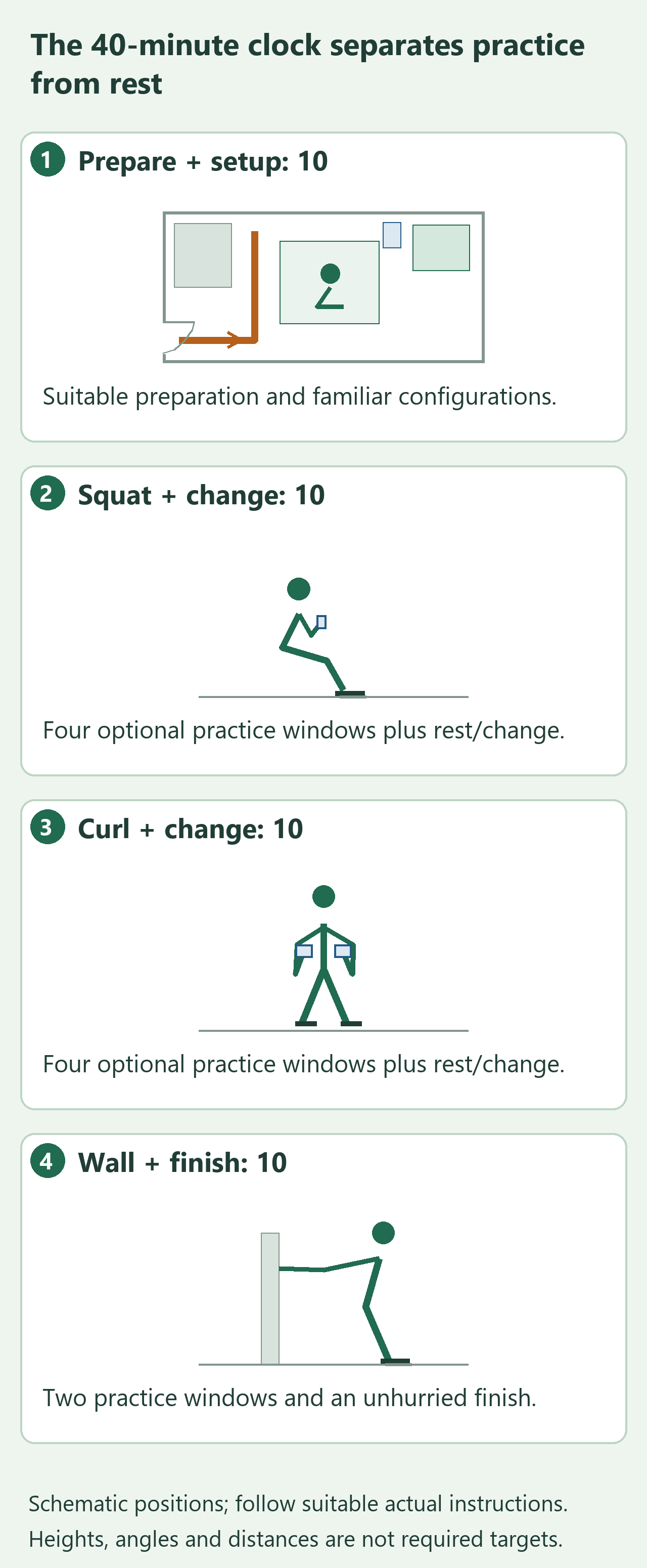
| 10:00–18:00 | 8 minutes goblet-squat opportunities. | Four 2-minute windows, each allowing a brief suitable set and rest. |
| 18:00–20:00 | 2 minutes rest and change. | Put weights down appropriately, rest and establish the curl setup. |
| 20:00–28:00 | 8 minutes hammer-curl opportunities. | Four 2-minute windows, each allowing a brief suitable set and rest. |
| 28:00–30:00 | 2 minutes rest and change. | Store weights outside the route and establish wall contact. |
| 30:00–36:00 | 6 minutes wall-press opportunities. | Two 3-minute windows, each with suitable practice and rest. |
| 36:00–40:00 | 4 minutes finish. | Unhurried appropriate recovery, short record and room reset. |
The allocations sum to 6 + 4 + 8 + 2 + 8 + 2 + 6 + 4 = 40 minutes. A window contains practice and rest; none requires continuous repetitions. You can leave a later opportunity unused.
Complete any more substantial room, product or support checks before the illustrative clock and record their time separately. NHS's specific standing warm-up is at least six minutes and can be longer. If appropriate preparation or rest takes longer, extend the actual total or omit later practice instead of rushing.
A worked count example, with honest arithmetic
If these familiar movements and amounts are appropriate under your relevant guidance, a worked version could use 6 goblet-squat cycles in a chosen squat window, 8 both-arms hammer-curl cycles in a chosen curl window and 6 wall-press cycles in a chosen wall window. These are original illustrative counts, not required doses.
At the example tempos, six squat cycles would occupy about 36 seconds, eight complete curls about 40 seconds and six wall presses about 30 seconds, assuming the timing is actually maintained. The remaining window is available for rest and reset. A different starting reset, actual timing or interrupted attempt changes that arithmetic.
You may use fewer cycles, fewer opportunities or a separately instructed amount. Do not shorten needed rest or finish a count with changed movement simply to match the worked example.
Goblet squat: the weight does not set your depth
ACE describes holding one dumbbell vertically at the chest, elbows close, in a standing position about shoulder-width. Keep the back controlled while lowering and returning. Use an appropriate familiar range instead of forcing a deep position because the source or a picture shows one.
Keep reliable foot contact, move the hips and knees with control and rise smoothly. The added tempo should not make you hold your breath or collapse toward the bottom. If the movement or load is uncertain, obtain appropriate instruction rather than treating this timetable as a starting assessment.
Hammer curl: keep the neutral grip and elbows clear
ACE describes a neutral grip with palms toward the body, thumbs around the handles and wrists controlled. Begin with dumbbells near the thighs, establish the comfortable standing setup and gently engage the trunk. Curl toward the front of the shoulders without elbow drift or shoulder lifting, then lower with control.
The worked count here uses both arms together: one lift and return is one cycle. If you alternate arms, record each side separately rather than carrying over the same number without explanation. Use a comfortable aligned grip rather than forcing a wrist position to make the weights sit tightly beside the body.
Wall press-up: a separate bodyweight block
NHS describes standing at arm's length with hands at chest height, slowly bending the elbows toward the wall and pushing back. Use a suitable wall and clear standing contact. The cycle includes the controlled approach and return.
This block adds a pressing task; it does not make the limited session a complete whole-body program. Do not replace the wall with a movable chair, stack of objects or unknown support to preserve the clock.
Finish from the actual session, not the planned total
Record completed cycles, actual load, movement version, timing intention, actual rests and unused windows. A useful note might say “three of four squat opportunities used; tempo removed in the last set to retain appropriate control.” Keep that change visible.
Stop immediately if pain occurs or you become unwell, consistent with NHS's general exercise safety advice, and seek appropriate guidance for symptoms or uncertainty. Repeating, reducing or resting may be the next useful choice. No fixed count or 40-minute completion qualifies a heavier load.
The 40-minute clock separates practice from rest
Examples to work through
These fictional examples illustrate practical choices and observations.
You need longer preparation
Keep the appropriate preparation and revise the actual total or leave a later window unused. Do not begin loading a movement early just to preserve the 40-minute example.
The timing demand changes the squat
Remove or revise the optional tempo under relevant guidance. Record the actual range and control rather than forcing a deep or slow movement to make the digits look correct.
You alternate hammer curls
Record completed lift-and-return cycles for each arm. The worked both-arms count is a different unit and cannot be compared directly without stating the version.
You skip the final wall-press opportunity
Keep the unused opportunity and actual rest in the record. The example clock reserves time; it does not require another set or a rushed final count.
Dumbbell tempo session: actual windows, units and rests
Use these optional reminders to mark fields you want to keep in your own notes. The downloadable blank sheet contains every record field. Keep your completed record in your own appropriate private place.
Frequently asked questions
Is this forty minutes of continuous exercise?
No. The clock includes preparation, setup, practice, rest, transitions and finishing. Each movement window can contain a brief suitable set and the needed rest.
Are the tempos and counts prescribed by ACE or NHS?
No. They are original illustrative timing and count examples. Sources support the specific movement descriptions and separate preparation guidance.
Why does hammer-curl tempo list lowering first?
The notation always lists lowering, lowered pause, lifting and reset. A curl starts with hands down and therefore begins with the lifting phase. Record the actual start and complete lift-and-return cycles.
What weight should I use?
Use familiar appropriate loads under relevant instruction. This page does not choose an individual weight or use a short repetition trial as a load or readiness assessment.
Sources and what they support
- ACE Exercise Library: Goblet Squat
Vertical dumbbell held at the chest, standing setup and controlled squat movement. This guide does not impose a universal depth.
- ACE Exercise Library: Hammer Curl
Neutral grip, controlled wrist and elbow position, curl and lowering, and clear single- or both-arm versions.
- NHS: Strength exercises
Stable chair and seated fit; sit-to-stand, supported calf raise and wall press-up descriptions, example counts and gradual build-up.
- NHS: How to warm up before exercising
The specific standing warm-up takes at least six minutes and can be longer. The accompanying general exercise advice includes stopping for pain or becoming unwell and obtaining appropriate guidance when suitability is uncertain.
The diagrams, fictional cases, records and combined session calendars are original educational aids. The listed sources inform the specific guidance described above; they do not prescribe every example timing or assess your individual situation.