Practical guide
Small-Apartment Workout Space: A Movement-Clearance Checklist
A mat fitting between the furniture does not establish that your workout fits. Check where your arms and legs travel, how you enter and leave each position, the floor and any support, and the route through the room. Resolve a relevant obstacle before starting; shortening the session does not remove it.
Start with the movements you actually plan to do
Choose the session before judging the room. A standing movement, a floor exercise and a supported exercise use space differently. A room that accommodates one familiar movement may not accommodate another, even when both are described as low impact or suitable for a small space.
List the positions you will use and where your limbs travel. Include side steps, backward steps, reaching, turning and transitions between positions. Do not use the length of a mat as a universal measure of how much space a person or routine needs.
The checklist below is an original practical planning aid for familiar, suitable exercises. It does not set a minimum room size or assess whether an exercise suits your health. If you are uncertain about the exercise itself, resolve that separately before using the room check.
Compare a mat footprint with a movement footprint
Download the room sketch as SVG.
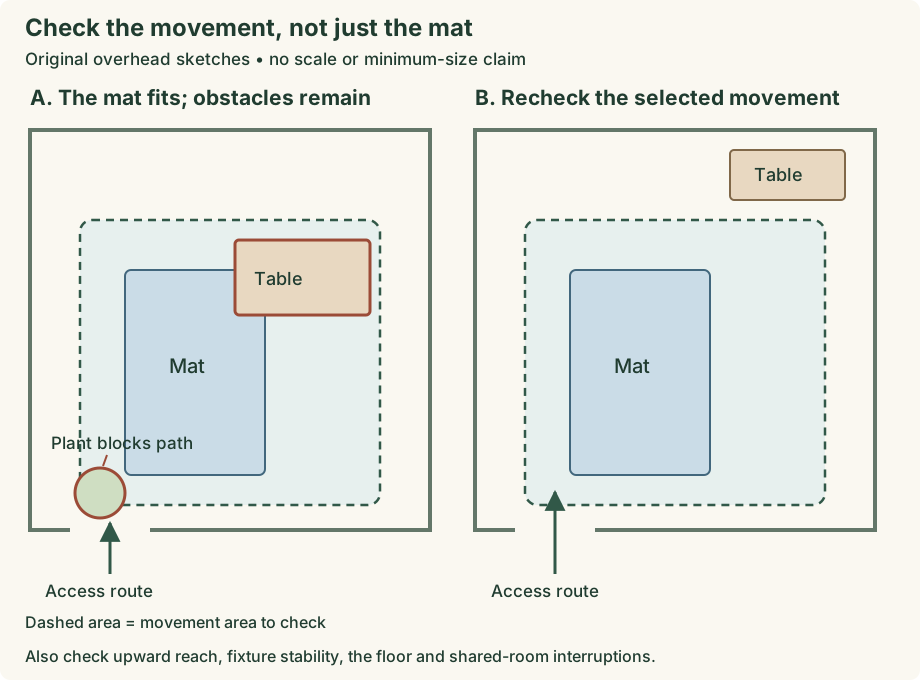
In sketch A, the mat fits, but a table overlaps the movement area and the plant interferes with the route into the space. An empty rectangle under the mat therefore does not settle the whole setup.
Sketch B relocates those obstacles in the example. You still need to check the actual movement, upward reach and floor in your own room. The second picture is a prompt for that check, rather than a drawing that certifies a particular apartment as safe.
Eight checks before the timer starts
- Floor and mat. Clear loose objects, spills and cables from the area you will use. Check any mat for sliding, bunching or raised edges. A mat should not conceal an unresolved surface problem or become a trip point itself.
- Forward and backward travel. Consider the whole movement, including a step back, a turn or a change in stance. Leave the exercise out if you cannot establish enough room to perform it with control.
- Sideways travel. Check both sides of the body. A clear space on your right does not establish clearance for your left arm, left leg or the opposite direction of a step.
- Upward reach. Look for low fittings, shelves and a ceiling fan’s moving area. A floor plan cannot show everything overhead. Choose a different suitable position or movement if the reach conflicts with an obstacle.
- Transitions. Include getting down, getting up and reaching any support you need. Do not judge a floor exercise only from the position in which you will hold it.
- Support. Establish that a chair, wall or fixed surface is suitable for the particular exercise. NHS chair-exercise guidance specifies a solid, stable chair without wheels that will not slip on its surface. That does not approve every piece of furniture for leaning, stepping or pressing.
- Access route. Keep the doorway and the route through the room available. Moving clutter away from the mat but into the route merely relocates the problem.
- Shared-room and device setup. Agree how people and pets will stay clear during the session. Put the screen, timer and any cables where you can use them without reaching through an obstacle or repeatedly crossing the activity area.
Check the actual setup again after moving furniture, changing the mat or selecting a different exercise. The relevant question is whether today’s movement and environment fit together, rather than whether the room was usable for another session.
Check position and access before adding effort
Once obvious obstacles are resolved, consider the starting position, the movement path and the way back out. For a familiar exercise, a slow, comfortable walkthrough can reveal that a knee, hand or foot travels beyond the mat. Keep it easy and stop if the setup or movement is uncertain.
This is a way to inspect the arrangement, not a test to pass by pushing farther or adding speed. Do not lean hard into uncertain furniture to find out whether it will move. Do not keep moving on a surface you already suspect will slip.
If the planned movement cannot fit comfortably with control, choose an appropriate alternative that actually fits, use another suitable space or pause. Avoid twisting around furniture or forcing a shortened movement simply to complete the selected routine.
Separate a space problem from a noise or time problem
| Concern | What to resolve | What does not settle it |
|---|---|---|
| A table intersects the movement path | Move the obstacle appropriately, change to a suitable movement or use another space. | A shorter timer or quieter music. |
| A support slides or its suitability is unknown | Leave it out and establish a suitable setup before the exercise. | Doing fewer repetitions on the same support. |
| The movement is noisy for the shared setting | Choose an appropriate lower-impact option or a suitable time and place, respecting the actual setting. | Assuming a mat guarantees silence or proves floor safety. |
| The session is longer than your available time | Choose a shorter suitable session with its setup and transitions checked. | Rushing the repetitions or skipping the environment check. |
A quiet exercise can still need sideways or overhead room. A brief exercise can still use an unsuitable chair. Identify the concern first so the adjustment addresses it.
Make the shared-room plan easy to repeat
Keep preparation specific: which objects move, where they go, and which area stays available for others. Choose a temporary storage place that does not block a door or create a second trip point. If moving a heavy item is impractical or uncertain, use a different suitable space rather than making rearrangement part of the workout.
Arrange the screen before you begin. You should not need to pick up a device from the floor mid-movement or step over its charging lead to see the next instruction. If an interruption changes the space, stop and recheck before resuming.
After the session, return equipment and movable items to their intended places. Store weights or other tools where they will not roll into a route or be left underfoot. A repeatable setup includes clearing away as well as getting ready.
A clear room does not decide exercise suitability
NHS exercise-video safety information describes its exercises as general exercises and advises getting professional guidance when suitability is uncertain or relevant health circumstances apply. It says to stop immediately if you feel pain or become unwell.
Use that boundary with the space check. If you feel pain or become unwell, stop; do not keep trying room arrangements as a substitute for appropriate advice. A tidy floor cannot establish that an unfamiliar movement is right for you.
For chair-based exercises, follow the actual exercise guidance and its chair requirements. For other equipment, use its instructions and intended purpose. A dining chair suitable for sitting is not automatically a step platform or a pressing support.
Keep a short movement-clearance record
Download the editable setup record. Record the movements, clearance, transitions and concerns that need resolving.
Chosen movement: a familiar standing exercise
Where the body travels: forward, sideways and upward
Obstacle found: shelf within the planned upward reach
Action: choose another suitable position or exercise
Doorway and access route: check after moving items
Floor and support: still need checking before starting
Timer: begin only after relevant setup concerns are resolved
Write what changed rather than simply “room passed.” If you choose a different movement next time, use that movement’s path for the next check. The record is a practical reminder, not a safety rating.
Three checks for a small-apartment setup
These original cases focus on the environmental concern that the adjustment must actually resolve.
Case 1
Your mat fits between the sofa and table, but an arm reaches the table during the chosen movement. Does a shorter workout resolve the issue?
Show answer and explanation for case 1
No. Resolve the movement-path conflict before starting.
Move the obstacle appropriately, use a suitable alternative that fits or choose another space. A shorter duration does not change where the arm travels.
Case 2
Moving loose items off the mat blocks the doorway route. Is the whole setup now ready?
Show answer and explanation for case 2
No. Keep the access route available as well as the activity area.
The transition into and out of the space matters. Choose a storage location that does not relocate the obstruction into the route.
Case 3
A workout is labeled low impact. Can you assume it needs no sideways or overhead clearance?
Show answer and explanation for case 3
No. Check its actual movements and transitions.
Impact describes a different aspect of the activity. A quiet movement can still involve reaching or stepping beyond the mat.
Sources and further reading
- NHS: Strength exercisesSpecific chair suitability instructions: stable, no wheels and no slipping; gradual and controlled home-exercise guidance.
- NHS: Strength and Flex exercise-video safety informationGeneral-exercise scope, advice when suitability is uncertain and stopping for pain or becoming unwell. No movement video analysis is claimed.