How to Progress Home Workouts: Repeat or Change One Clear Factor
Revised · General adult exercise education
A useful progression decision starts with the actual suitable movement and conditions. Review what you practised, then choose repeat, reduce, rest, resolve a question or make one appropriate named change. A larger count, two successful repetitions or a new week is not a readiness certificate.
Decide what the next practice needs
Progression is often presented as “add more each week.” That leaves out the actual room, equipment, movement version, support, comfort and rest. Those details determine whether two records describe comparable practice and what question needs attention next.
This guide provides a practical decision framework for general adult learning. NHS and ACE support the named movement and preparation guidance linked here; they do not prescribe this whole framework or a universal threshold for increasing practice.
The bodyweight log guide explains how to record repetitions, sides, seconds and rests. This page focuses on interpreting those records and choosing the next action.
First check whether the setup has changed
A new mat, different chair, changed support need, rearranged room or different band connection can change the task before you begin. Resolve suitability and the matching instructions first. A familiar movement on an unresolved surface is not a progression opportunity.
Do not use a few repetitions to certify equipment. Chair sitting support does not establish step-platform or pressing use. A band pull does not clear an uncertain anchor or foot arrangement. Use the chair-role guide and band inspection guide for those product decisions.
Then compare like with like
On a narrow screen, scroll this table sideways to read all columns.
| Compare this | Useful question | A misleading comparison |
|---|---|---|
| Movement version | Were both records for the same named task and support? | Adding chair-touch squats to full sit-to-stand counts. |
| Range and cycle | Did both include the intended outward phase and return? | Comparing complete bridges with a raised hold. |
| Counting unit | Were sides, pairs or both-arm cycles stated the same way? | Treating two bird-dog cycles as two pairs. |
| Timing and rest | Were actual rests and changed timing visible? | Calling a whole practice window continuous exercise. |
| Conditions and comfort | What changed in the situation or appropriate instructions? | Assuming a larger number under different conditions proves improvement. |
A changed record is still useful. Label it accurately rather than discarding it or turning it into a direct score against the earlier session.
Choose among five practical next actions
1. Repeat a suitable recognizable practice
Repeat when the current appropriate version remains useful. You can improve the clarity of a controlled return, side count or setup observation without adding a demand. Repetition of a manageable version is not failure to follow the calendar.
2. Reduce or revise the actual practice
A shorter practice, fewer opportunities or more rest may fit the current situation. If a version or range needs change, follow appropriate instruction for it and label the difference. Do not silently alter several factors and compare only the new total.
3. Rest or leave a diary slot unused
The calendar is a planning tool. Keep an unused slot visible and resume appropriate practice without doubling a later session to catch up. This page does not set a universal recovery interval or diagnose how an individual should respond to symptoms.
4. Resolve a setup, movement or health question
Get matching manufacturer guidance for an uncertain product configuration, and appropriate professional guidance for an uncertain movement, support need or health concern. Adding a count is not a solution to a question about whether the task is suitable.
5. Make one appropriate named change
If a change is suitable under your relevant instruction, identify it: amount, comfortable range, timing intention, load or a separately instructed version. Keep the remaining factors clear. A new band, unsupported chair task or loaded movement may introduce new equipment and instruction requirements.
For example, “same suitable squat version and range; one additional cycle under appropriate guidance; rests unchanged” states a change. It does not recommend that every reader add one cycle, and it does not make two prior sessions a qualification test.
Use control observations in the actual movement
ACE's squat guidance emphasizes foot and trunk control through lowering and return. Its bridge entry describes controlled lifting without excessive lower-back arching and deliberate lowering. Bird dog maintains the intended back and hip position during the opposite-limb reach.
Those cues help describe the current version. They do not establish that a maximum depth, raised leg or long pause is always better. If an added timing or range demand changes control, end the set and review the appropriate practice rather than forcing the target.
NHS's sit-to-stand example includes both standing and a controlled sitting return. Record that complete cycle rather than only the successful rise. If more support is needed, obtain appropriate instruction for the supported version instead of treating arm-free movement as a compulsory progression.
Keep comfort and recovery observations separate from diagnosis
Write what you actually noticed and any relevant instruction you followed. A record can say “practice reduced because the current situation differed” without assigning a medical cause.
NHS's accompanying exercise safety advice says to stop immediately if pain occurs or you become unwell. Follow that advice and obtain appropriate guidance for concerning symptoms or uncertainty. This framework does not prescribe rehabilitation, interpret every discomfort or supply a universal symptom score.
Turn the decision into a small next-session note
Write the chosen action, actual version, one intended change if any, needed preparation and unresolved question. For example: “repeat the suitable chair session; same support; retain rests; record controlled returns separately.” That gives the next practice a recognizable starting point.
The three-week chair calendar and six-week bodyweight calendar show complete example schedules. Neither requires increases or catches up missed practice.
Review the next actual record with the same questions. A clearer version, a resolved setup or an appropriate decision to rest can be useful outcomes alongside completed practice. The decision should remain tied to the actual appropriate practice rather than a promised strength result.
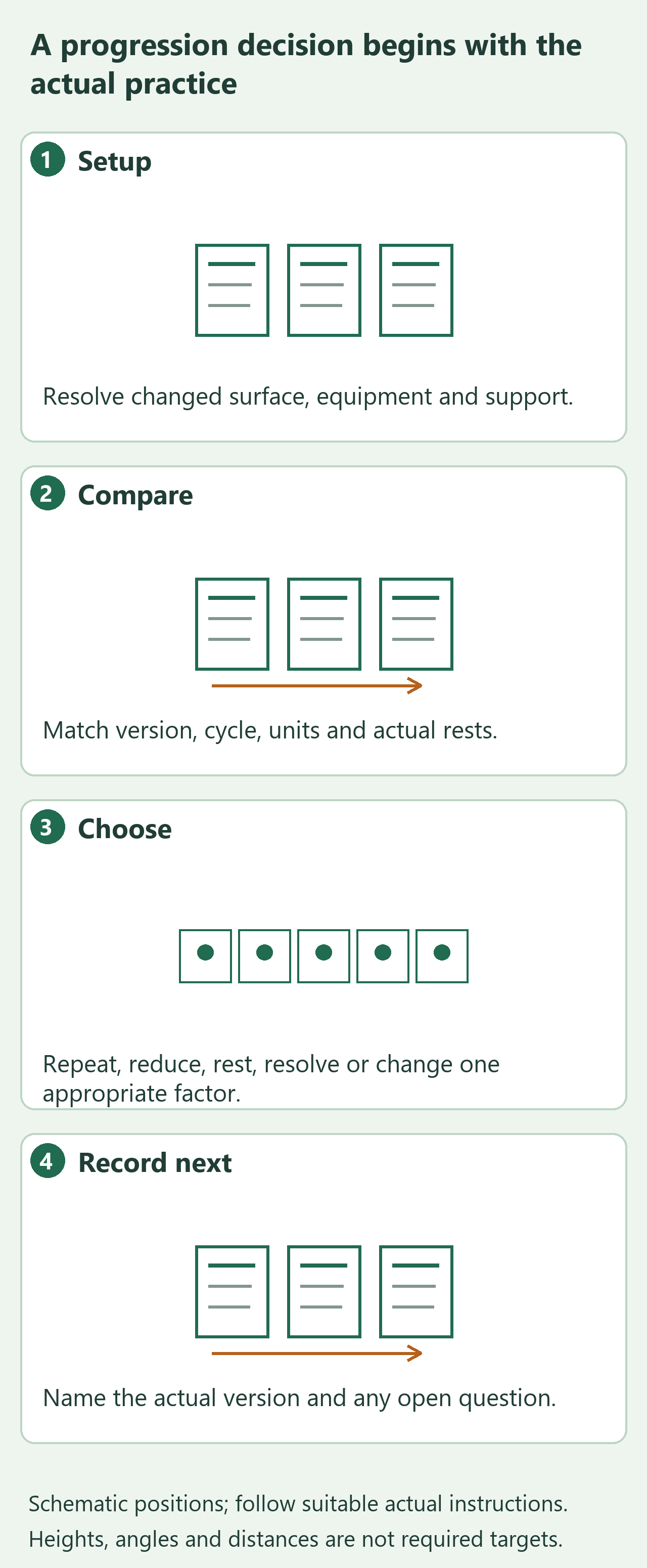
A progression decision begins with the actual practice
Examples to work through
These fictional examples illustrate practical choices and observations.
The count rose but the range changed
Label the new range and actual completed cycles. The sessions describe different practice, so do not treat the larger number alone as proof of improvement. Decide from the appropriate current version and observations.
Two sessions felt manageable
Keep that observation with the version, setup, comfort and rest. It does not certify harder movement. Repeating or following one appropriate instructed change are separate choices to consider.
A different band was added
Identify its actual product instructions, configuration and permitted adjustment before practice. The earlier movement record does not approve the new elastic or connection.
A missed session creates pressure to catch up
Keep the diary slot unused and resume appropriate practice. Do not double a later session just to preserve a calendar total; the next useful action depends on the actual situation.
Next-practice decision note
Use these optional reminders to mark fields you want to keep in your own notes. The downloadable blank sheet contains every record field. Keep your completed record in your own appropriate private place.
Frequently asked questions
Do I need to increase something every week?
No. Repeat, reduce, rest or resolve a question when appropriate. A calendar organizes opportunities; it does not establish readiness from the week number.
Are two successful repetitions a progression test?
No. A brief practice does not certify medical readiness, equipment suitability or permission for a harder movement. Review the actual version and relevant instructions.
What does changing one factor mean?
Name the appropriate change, such as amount or a timing intention, and keep the other conditions visible. If the movement, support or product also changes, describe those new requirements.
What should I do when the setup is uncertain?
Resolve the actual product, surface or support question before further practice. A different workout or lighter trial does not automatically establish suitability.
Sources and what they support
- ACE Exercise Library: Bodyweight Squat
Standing setup, controlled hip and knee movement, foot and trunk control, comfortable range and standing return.
- ACE Exercise Library: Glute Bridge
The basic two-feet floor position, abdominal control, lifting without excessive back arch and controlled lowering.
- ACE Exercise Library: Bird Dog
Hands-and-knees setup, opposite-limb reach, back and hip control, and return to the starting position.
- NHS: Strength exercises
Stable chair and seated fit; sit-to-stand, supported calf raise and wall press-up descriptions, example counts and gradual build-up.
- NHS: How to warm up before exercising
The specific standing warm-up takes at least six minutes and can be longer. The accompanying general exercise advice includes stopping for pain or becoming unwell and obtaining appropriate guidance when suitability is uncertain.
The diagrams, fictional cases, records and combined session calendars are original educational aids. The listed sources inform the specific guidance described above; they do not prescribe every example timing or assess your individual situation.