Three-Week Chair-Supported Strength Plan: A Complete Calendar
Revised · General adult exercise education
This three-week example shows six chair-focused practice opportunities. Use the same suitable basic tasks to make setup and movement observations clear. Week numbers do not require increases: repeat, reduce, omit or revise a session under your appropriate guidance.
What this three-week plan contains
This is a small chair-focused practice plan for general adult learning, not a whole-body strength program or rehabilitation prescription. It uses chair sit-to-stand, upright seated hip marching and standing calf raises with suitable chair-back contact.
NHS strength and sitting guidance supports those movement descriptions and offers example counts. The six-session calendar, order and review prompts below are original arrangements, separate from the source routines.
Use only appropriate familiar tasks, preparation and support under your relevant instructions. If standing transitions, seated fit or exercise suitability are uncertain, obtain guidance before adopting those parts of the example.
Establish one recognizable chair session
Use the 15-minute chair-session explanation: suitable preparation, a sit-to-stand opportunity, an upright hip-march opportunity, a supported calf-raise opportunity and an unhurried finish. Rest and transitions belong inside the task windows.
Before the clock, establish the solid stable non-wheeled chair, suitable foot fit, condition, surface and clear standing route. NHS describes feet flat with knees at right angles and suggests an armless chair for its routines. Resolve different support needs with appropriate instruction, not improvised furniture changes.
On a narrow screen, scroll this table sideways to read all columns.
| Task | Worked count example | Counting unit and boundary |
|---|---|---|
| Chair sit-to-stand | NHS's example aim: 5. | Each cycle starts seated, stands and returns seated under control. |
| Upright chair hip march | NHS's example: 5 lifts each leg. | Each single-leg lift includes its controlled return; record right and left separately. |
| Supported calf raise | NHS's example: 5. | Lift and lower under control with the intended suitable chair-back contact. |
These counts make the source examples readable; they are not a required starting quota or a readiness test. Use less, stop, rest or follow a different individually instructed amount when appropriate. Do not move continuously for a whole two-minute window to make the count larger.
The illustrative session allocates six minutes to suitable preparation, three two-minute task opportunities and three minutes to finish. NHS's separate standing warm-up takes at least six minutes; a seated preparation needs its own appropriate instructions and may change this example's total.
All three weeks, with each session visible
Monday and Thursday below are example diary slots, not mandatory recovery intervals. Change the days, repeat a week or leave a slot unused when needed. Resume from the actual appropriate practice rather than trying to catch up missed volume.
On a narrow screen, scroll this table sideways to read all columns.
| Week and slot | Actual task sequence | What to observe |
|---|---|---|
| Week 1, Monday | Preparation → sit-to-stand → upright hip march → supported calf raise → finish. | Chair fit, standing route and the version or assistance used. |
| Week 1, Thursday | Repeat the same suitable sequence and an appropriate amount. | Can you describe complete cycles and actual rests without mixing units? |
| Week 2, Monday | The same sequence; retain or revise the actual suitable practice. | Controlled sitting return, upright single-leg marching and heel lowering. |
| Week 2, Thursday | Repeat the appropriate sequence, allowing needed preparation and rest. | Has the chair, support, room, comfort or instruction changed? |
| Week 3, Monday | The same recognizable sequence; any appropriate change must be named. | Keep one change clear instead of changing count, speed and support together. |
| Week 3, Thursday | Repeat, revise or omit tasks according to the actual situation. | Summarize the version worth keeping and any question still unresolved. |
Each slot points to the actual chair tasks above. No week requires a load increase, faster tempo, unsupported standing version or a switch to a different workout.
Week 1: make the setup and record trustworthy
The first useful outcome is a clear appropriate session. Name the chair, support version and actual movements. Record complete sit-to-stand cycles, each hip-march side and calf-raise cycles separately, together with rest and elapsed time.
If a task or transition is unsuitable, omit it and keep the revised session visible. Completing a short manageable practice is not a medical assessment or evidence that the chair can be used as a step platform.
Week 2: review control before adding a demand
Look at the sitting return, upright torso during marching and controlled heel lowering. If those change during a set, end the set and review suitable practice or instruction. A number that increased while the movement changed is not directly comparable.
Repeat the same appropriate arrangement when useful. If the room or support needs changed, address that first. Do not use a bigger count to compensate for a missed diary slot.
Week 3: keep or revise one named feature
A next choice can be repeating the same appropriate amount, using less practice, allowing more rest or following a suitably instructed change. If you change something, name it so the next record can be compared. A week number alone does not establish readiness.
Removing needed support, adding weight, stepping onto the chair or switching to chair dips are different tasks, not automatic stages of this plan. Establish separate appropriate instruction and equipment requirements before such changes.
Review the three weeks without a pass/fail score
Ask which setup and version were appropriate, what actual practice you completed, what observations repeated and what needs guidance. Keep missed or revised sessions in the record. The next useful plan may repeat a week or preserve the same chair tasks.
Stop immediately if you experience pain or become unwell, consistent with NHS's exercise safety advice, and obtain appropriate guidance for symptoms or uncertainty. This calendar promises no clinical result or fixed strength gain.
Use the progression guide for interpreting the next choice and the bodyweight record guide for units. The blank calendar below can be kept privately.
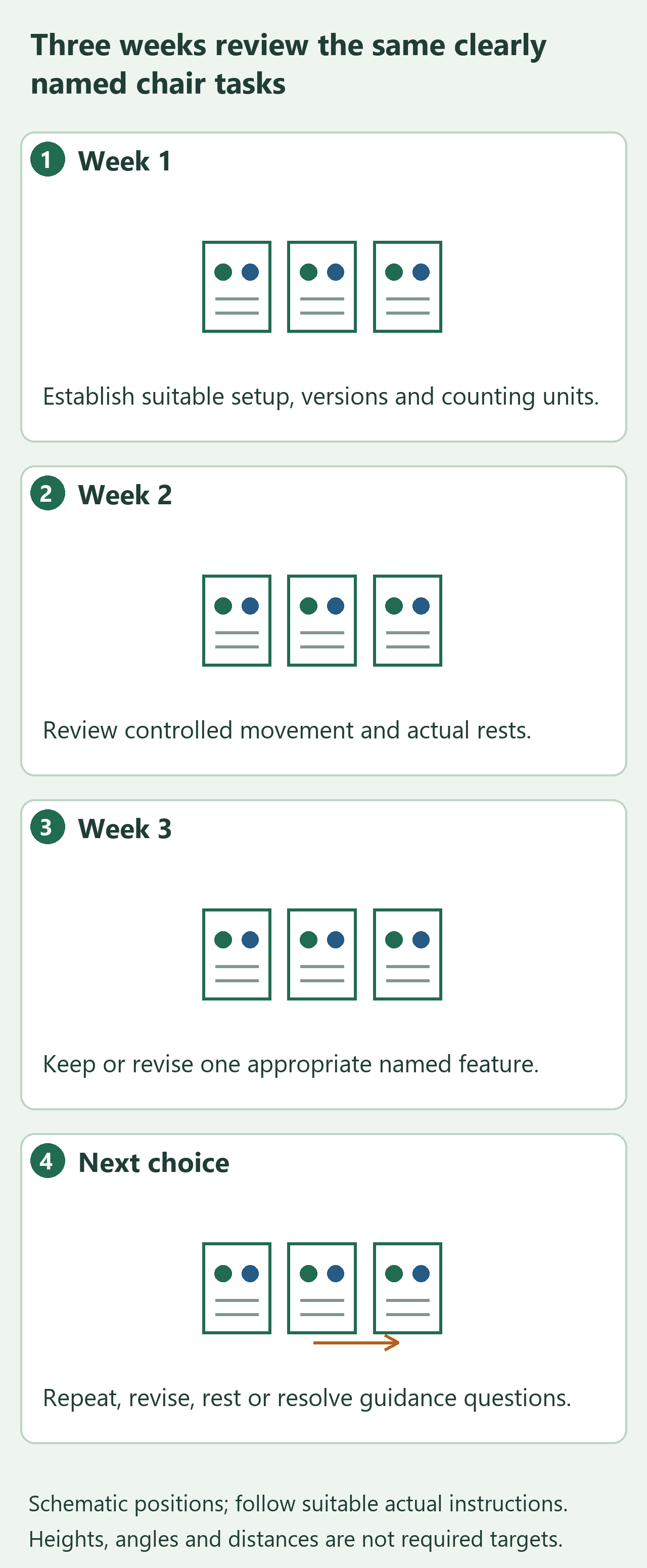
Three weeks review the same clearly named chair tasks
Examples to work through
These fictional examples illustrate practical choices and observations.
Week 1 includes only one appropriate session
Record the actual session and leave the other slot unused. Repeat the week or revise the diary under relevant guidance; do not double a later session to catch up the example calendar.
The same counts work well in Week 2
Keeping the same appropriate version and amount is allowed. Use the week to make movement and rest observations clearer; a new week does not require a larger number.
Support needs change in Week 3
Resolve the new support or transition requirements first. Keep that change visible in the record instead of comparing the session directly with an earlier arm-free or differently supported version.
You want the next plan to feel more substantial
Review actual practice, control, comfort and relevant guidance before choosing an appropriate next change. Do not automatically add weight or change the chair’s role because three weeks have passed.
Three-week chair plan: six actual-session entries
Use these optional reminders to mark fields you want to keep in your own notes. The downloadable blank sheet contains every record field. Keep your completed record in your own appropriate private place.
Frequently asked questions
Can I repeat the same chair session for three weeks?
Yes, when it remains appropriate under your relevant guidance. The calendar keeps sit-to-stand, upright hip marching and supported calf raises recognizable, while reviewing setup, control, rest and changed conditions. No weekly increase is compulsory.
Must I complete five repetitions of everything?
The table names NHS’s example counts, not universal quotas. Use an amount and support appropriate to your situation and instruction, keeping rest and any revised practice visible.
Should I increase the count each week?
No automatic increase is set. Repeating, reducing or revising practice can be appropriate. Any suitable change should be named rather than assumed from the week number.
What if I miss a session?
Record the unused slot and resume appropriate practice without catching up extra volume. Changing days or repeating a week is allowed in this illustrative calendar.
Sources and what they support
- NHS: Strength exercises
Stable chair and seated fit; sit-to-stand, supported calf raise and wall press-up descriptions, example counts and gradual build-up.
- NHS: Sitting exercises
Stable chair, seated fit and the upright single-leg hip march. Use its own movement instructions and suitability guidance.
- NHS: How to warm up before exercising
The specific standing warm-up takes at least six minutes and can be longer. The accompanying general exercise advice includes stopping for pain or becoming unwell and obtaining appropriate guidance when suitability is uncertain.
The diagrams, fictional cases, records and combined session calendars are original educational aids. The listed sources inform the specific guidance described above; they do not prescribe every example timing or assess your individual situation.