Practical guide
How to Log Bodyweight Exercise: Range, Tempo and Repetitions
Write the exercise version, comfortable range, named movement phases and counting unit before comparing repetitions. Use three complete fictional records for wall press-ups, squats and bird-dog, then check whether two sessions used similar conditions. Keep estimates, changed attempts and per-side counts visible.
Begin with a recognizable repetition, not just a total
A useful bodyweight log names the movement, its version, the range you used and the way you counted it. “Push-ups: 10” leaves too much missing: the hands might be on a wall, on a fixed counter or on the floor; the last few repetitions might use a shorter range. Those are different observations even when the total is identical.
Define the start, the movement and the return before the set. For a wall press-up, a recording unit can be one controlled lowering-and-return cycle. For an alternating movement, say whether a repetition means one side or a complete left-and-right pair. Keep the same definition when you compare sessions.
This is a record of familiar, suitable exercise for generally healthy adults. It is not a diagnostic test, a rehabilitation plan or a validated strength score. If a movement or your health circumstances are uncertain, resolve that with appropriate professional guidance before using the worksheet.
| Field | Example of what to write | Why keep it? |
|---|---|---|
| Movement and version | Wall press-up; both feet on the floor. | Keep knee-supported, raised-hand and floor versions separate. |
| Support and contact | Same wall area, hand height and foot position. | Record enough detail to recognize a changed setup. |
| Start and return | Standing start; return to that position. | Define what completes one repetition. |
| Range cue | Comfortable elbow bend with back position maintained. | Describe the endpoint without forcing a target depth. |
| Named phase timing | Lower about 2 seconds; return about 2 seconds. | Mark estimates and label pauses separately. |
| Counting unit | One lower-and-return cycle; per-side when needed. | A paired cycle and a single-side cycle are different units. |
| Set result | 6 attempted; 5 within the stated range and control. | Keep an unfinished or changed repetition visible. |
| Rest and placement | About 90 seconds; first movement after warm-up. | Distinguish set rest from a pause within a repetition. |
| Observation | Last repetition shortened; ended the set. | Write what happened rather than giving a pass score. |
| Next comparison | Repeat a suitable version with the same recording key. | Change the comparison label when the conditions change. |
Record the range you used without chasing a depth target
Range means how far you moved between the starting and finishing positions. In a home log, a simple description can be more honest than an unmeasured joint angle. “Comfortable elbow bend, trunk moving together” tells you something usable; “full range” without a definition may not.
The NHS wall press-up describes a straight back and slow bending and returning. The ACE squat description discusses the downward and upward phases, foot contact and the points at which position begins to change. Neither source gives a universal home-log depth that proves every reader has completed a good repetition.
Choose a comfortable, controlled description that fits the actual movement and guidance you use. Examples include “heels stayed on the floor during my chosen squat range” or “bird-dog reach ended before the low back position changed.” Do not force contact with a counter, deeper squatting or a higher limb lift to match a previous number.
A reference can help identify the arrangement: the same wall spot, a measured fixed support height or a written stance description. A measurement identifies that setup; it does not calculate the force you produced or certify the support. If you change the reference, name the change.
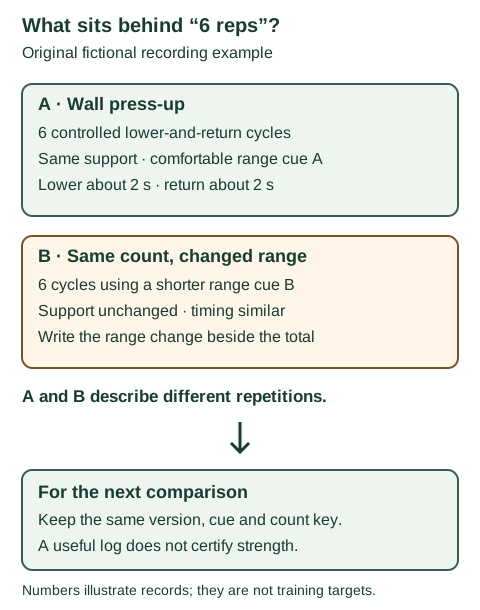
Note an intentional shorter range as its own version. If range shortens unexpectedly during a set, record which repetitions still met your stated description and why the set ended. You can keep the attempted total without pretending that every attempt was equivalent.
Name each phase instead of leaving an unexplained tempo code
Tempo is the pace of the movement and any pauses within it. Write the phase names in your log so the next reader, including your future self, knows what a number means. For a squat, “lower about 3 seconds, no deliberate bottom pause, rise about 2 seconds, brief reset standing” is more interpretable than “3–0–2–1” without a key.
You can use a compact code once you have written its order, units and meaning. Keep that key next to the exercise. Do not assume that a four-number code starts with the first movement you perform, or that somebody else’s plan uses your order. A bird-dog reach is easier to describe as extend, hold and return than as an unexplained down-and-up code.
Distinguish planned timing from observed timing. If your plan said “lower 3 seconds” but you did not check it, write “planned 3 seconds; actual not measured.” If you estimated by counting, say “about 3 seconds, estimated.” Do not turn an estimate into a precise measured result.
A pause within a repetition is separate from the rest between sets. “Hold the extended bird-dog position about 2 seconds” and “rest about 60 seconds after the set” describe different parts of the session. Keep breathing; counting a pause is not an instruction to hold your breath.
The timings below are original fictional examples of recordkeeping. They are not recommended optimal tempos, prescriptions from NHS or ACE, or evidence that slower movement always gives better results. End a set when control changes instead of speeding up to complete a written total.
Three complete fictional movement records
These examples show how to fill the fields; their counts and timings are not amounts you need to copy. Follow appropriate instructions for the actual exercise and your situation.
Wall press-up. NHS describes hands at chest level, a straight back and slow movement. Use the support-choice comparison when deciding between a wall, fixed counter and floor version. The record below stays with the wall version so its unit remains clear.
Wall press-up
Setup: Standing wall version; hands at chest level on the same sound wall area, feet in the same recorded position.
Range and repetition: One comfortable lower-and-return cycle; back position maintained.
Tempo: Lower about 2 s; return about 2 s; no deliberate end pause. Estimated, not timed.
Result: One set: 6 attempted; 5 met the written range/control cue. Sixth shortened; set ended.
Rest and context: About 90 s after the set. No pain recorded; last repetition lost the stated range.
Next comparison: Compare the 5 qualifying cycles with a future record using this same key.
Bodyweight squat. ACE describes controlled downward and upward phases and monitoring foot contact and body position. The range note below records a comfortable chosen endpoint, rather than claiming a measured angle or prescribing a universal depth.
Bodyweight squat
Setup: Standing, no added load; same comfortable stance and suitable floor.
Range and repetition: One lower-and-return-to-standing cycle; chosen comfortable depth with heels down and position controlled.
Tempo: Lower about 3 s; rise about 2 s; brief standing reset. Estimated.
Result: One set: 5 attempted; 5 met the chosen cue. Range described, no joint angle measured.
Rest and context: About 90 s after the set; first movement after the usual warm-up.
Next comparison: Use the same stance, cue and timing description for the next descriptive comparison.
Alternating bird-dog. ACE describes raising opposite limbs and limiting their height to what can be controlled without changing low-back position. Log each side and define whether a count means a single-side cycle or a pair.
Alternating bird-dog
Setup: Hands and knees on a suitable non-sliding surface; opposite arm and leg reach.
Range and repetition: Extend and return one opposite-limb pair, without the recorded back position changing.
Tempo: Extend slowly; hold about 2 s; return slowly. Hold estimated; travel time not measured.
Result: Left leg/right arm: 4; right leg/left arm: 4. Eight single-side cycles, or four paired cycles under a different key.
Rest and context: About 60 s after the set. Both sides recorded separately; reach heights not measured.
Next comparison: Keep single-side counts and the same controlled reach cue; do not relabel eight cycles as eight pairs.
“Eight single-side cycles” and “four paired cycles” describe the same fictional bird-dog set using different units. Neither is a larger amount of work merely because its number is larger. Keep the unit written alongside the result.
Use a same-conditions comparison before calling a change progress
First check the version, setup, range cue, tempo key, count unit and rest. Then compare what happened. Keep the circumstances as similar as practical, while acknowledging that a home record cannot control every influence on a session.
| Two records | Comparison status | Careful interpretation |
|---|---|---|
| Same wall version, same cue and count key; 5 then 6 controlled cycles | Similar enough for a descriptive count comparison. | One more cycle met the recorded conditions; that alone is not a precise strength measurement. |
| Six cycles both days, but the second uses a shorter range | Range changed. | Keep both records; do not call identical counts identical performance. |
| Same squat count, different support or stance | Setup changed. | Name the new arrangement and begin a separate comparison. |
| Bird-dog recorded as 8 single-side cycles, then 4 paired cycles | Count key changed, amount may be the same. | Translate only when both side counts and definitions are known. |
| Same movement and cue, but timing was never checked | Timing comparability is unknown. | Write unknown rather than inventing a matching tempo. |
| Same count, but rest and workout placement differ | Context changed. | Describe the difference without attributing the result to one cause. |
| An extra attempt was unfinished or outside the stated cue | Attempted and qualifying counts differ. | Show both totals and the reason the set ended. |
| Pain or becoming unwell occurred | Exercise stops; progression comparison is secondary. | Follow appropriate advice; a log is not permission to test another version. |
Changing a condition does not make a session worthless. A shorter comfortable range or a more suitable support may be the sensible choice that day. It simply changes what you can conclude from the number. Write “different version” or “range changed” beside the total.
Even closely matched records are observations, not a laboratory test. A higher count can tell you what you completed under your stated conditions; it does not by itself establish why that happened, a percentage increase in strength, calories burned or readiness for a harder variation. Repeat a useful recording method instead of assigning a pass level.
Keep interrupted repetitions, timed work and holds distinguishable
If the set stops mid-repetition, record the completed cycles and the unfinished attempt separately. For example, “5 completed; sixth not returned to the start; ended because control changed” keeps the event visible. You do not need to hide the attempt or count it as an equivalent completed cycle.
A timed work interval is not a repetition count. “30 seconds available” may include movement, pauses or time spent getting into position. Write actual completed cycles separately if you counted them. If you only know the interval length, keep the count unknown.
A static hold is another unit. Write its position and observed duration; do not convert seconds into repetitions using an arbitrary formula. For an alternating movement, note whether the hold happened on each side and how you counted the returns.
Record rest as what occurred. “About 90 seconds” is honest when estimated; “planned 90 seconds, interrupted by a phone call” explains why a later set had a different context. Avoid dividing the workout duration by the number of sets and calling that calculated value the rest between each set.
The purpose is to make the record interpretable without turning exercise into a burdensome measurement project. A short note with a clear unit and one relevant change is often enough. Leave unobserved details unknown.
Six record-reading cases to practise
These original fictional cases apply the logging method. They are not exercise trials, measured performance results or individualized recommendations.
Case 1
Two records say six wall press-ups, but the second used a shorter comfortable range. Do the identical totals show identical performance?
Show answer and explanation for case 1
No. The range condition changed.
Keep both totals with their range cues. The count describes completed cycles under each version, not an interchangeable quantity. Choosing a shorter suitable range can be sensible; it simply limits the comparison. Do not force the earlier endpoint to make the records match or infer unchanged strength from the same total.
Case 2
You completed four left-leg/right-arm bird-dog cycles and four right-leg/left-arm cycles. How many single-side cycles and complete left-and-right pairs does that describe?
Show answer and explanation for case 2
Eight single-side cycles or four complete pairs.
The counts use different units. Keep both side counts and the definition beside the total. Four plus four gives eight single-side cycles; matching each left-side cycle with a right-side cycle gives four pairs. A record labeled eight pairs would describe twice as many side cycles and would misstate this example.
Case 3
A log says squat tempo 3–0–2–1, but gives no key. Can the next reader confidently identify every phase?
Show answer and explanation for case 3
No. The phase order and meaning need a written key.
Name the phases, their units and whether the values were planned, measured or estimated. For this guide’s squat example, plain words identify lowering, any bottom pause, rising and a standing reset. Another plan may define its code differently. A digit sequence alone does not establish the actual timing or the order of movement.
Case 4
A 30-second interval included getting into position and several pauses. Can you record it as 30 seconds of continuous movement or calculate its repetition count?
Show answer and explanation for case 4
No. Record the interval and observed movement separately.
The available time does not tell you how much of it was movement, and it does not establish the number of completed cycles. If you counted the cycles, write that total with its definition. If you did not, leave it unknown. Do not convert interval seconds to repetitions using an invented tempo or hide the setup and pauses.
Case 5
Six attempts were made; the first five met the chosen cue and the sixth did not return to the start. What belongs in the log?
Show answer and explanation for case 5
Six attempted, five qualifying completed cycles, and the unfinished attempt.
Write why the set ended and what changed. This preserves the event without counting unlike attempts as equivalent repetitions. The distinction is a personal recording convention, not a certified movement-quality score. End the set when control changes; if pain or illness occurred, stop and use the appropriate advice rather than treating the missing repetition as a target to retry.
Case 6
The next session has one more completed cycle, with similar recorded conditions. Does that prove a measured percentage increase in strength?
Show answer and explanation for case 6
No. It supports a descriptive comparison of the logged cycles.
State that one more cycle met the written conditions. A home log does not isolate every influence, measure force or establish the cause of a change. Count, range, setup, timing, rest and context help interpret the observation, but they do not convert it into a laboratory strength result or a universal qualification for a harder exercise.
Download a reusable log and use it for the next suitable session
Download the blank log, three completed examples and six explained cases. Copy the record into your own notes. Keep personal health details in your own record; the worksheet does not ask you to submit them.
Before starting, choose a suitable familiar movement and establish its setup. Use the fixed-counter setup guide for that specific pressing support, or the chair-selection guide when the actual movement uses a chair. The movement-clearance checklist helps with the room and transitions.
After the set, write the observed result before deciding what to compare next time. Repeating the same suitable version can give a clearer record than changing several conditions together. NHS strength guidance recommends building up gradually; this log does not create a fixed progression deadline or a repetition count that qualifies everyone for the floor.
NHS exercise-video safety information advises getting professional guidance when suitability or relevant health circumstances are uncertain. It says to stop immediately if you feel pain or become unwell. Follow that boundary; a shorter range, slower timing or missing count is not a reason to keep testing while symptoms continue.
Sources and further reading
- NHS: Strength exercisesWall press-up setup, slow movement and gradual build-up. Source repetition suggestions are not universal log targets.
- NHS: Exercise-video safety informationGeneral exercise scope, advice when suitability or health circumstances are uncertain, and stopping for pain or becoming unwell. Accompanying text only; no video-frame analysis.
- ACE Exercise Library: Bodyweight SquatDownward and upward movement phases, foot contact and position-control descriptions. No prescribed tempo or universal depth is inferred.
- ACE Exercise Library: Bird-dogOpposite-limb movement and limiting reach to what can be controlled without changing low-back position. Example counts and pauses are original fictional records.