Quiet Apartment Workout Setup: Movement, Floor and Timing
Revised · General adult exercise education
A quiet-apartment plan starts with the sound that actually causes a problem: footsteps, landings, equipment contact or music. Choose a suitable movement and time, handle tools with control and keep the floor trustworthy. No-jump movement and a mat can change the setting, but neither promises silence.
Identify the sound before choosing the solution
Quiet apartment exercise is a practical arrangement, not a guarantee attached to a workout label. A familiar march, a side step, putting down a weight and playing instructions through a speaker create different sounds. First identify which one matters in the real setting.
If someone has reported a problem, keep the observation specific: which movement, where it happened and roughly when. A statement such as “the repeated steps were audible downstairs in the evening” is more useful than “all exercise is too noisy.” You do not need an invented decibel figure to plan a sensible adjustment.
Check household and building arrangements that apply to you. A permitted activity time can still be inconvenient for a person in the room; a neighbour’s quiet period can differ from your preferred training window. Agree a workable setting where possible, without assuming that early morning or late evening will always be quieter.
Keep three checks separate
On a narrow screen, scroll this table sideways to read all columns.
| Question | What it asks | What it does not establish |
|---|---|---|
| Does the movement fit? | The feet, arms, transitions and stopping position have a workable path. | That the movement is silent or appropriate for every person. |
| Is the surface suitable? | Contact, grip, condition and any support requirements are resolved. | That a mat has soundproofed the room. |
| Does the sound fit the setting? | The actual activity, handling and timing are reasonable for the shared place. | That faster work, more effort or a smaller footprint is appropriate. |
A slipping mat belongs to the surface check. A side step approaching a table belongs to the movement-path check. Neither is resolved by turning music down or doing fewer repetitions on the same uncertain setup.
Choose movements you can control without jumping
For familiar suitable standing activity, an in-place march, comfortable heel dig or controlled standing knee lift can remove an airborne jumping phase. NHS's standing warm-up includes those movement families. Its routine does not promise that they are silent or prescribe a cardio session for every apartment.
Use the no-jump cardio guide to compare actual paths, pacing and effort. A small march can still be audible, and a stepping jack can still require sideways and overhead room. Choose by the actual movement, not by “apartment friendly” in a title.
Keep foot placement comfortable and controlled. If a selected familiar version is noisier or harder to control than intended, pause and consider a suitable change in pace, range or activity. Do not force a different walking pattern or awkward landing just to suppress sound.
A chair or floor option may reduce the amount of repeated standing foot contact in one setting. It also changes the task: chair suitability, safe transitions and the selected exercise still need checking. Choosing seated exercise solely because it is quieter cannot decide whether it suits your situation.
Handle equipment without dropping or improvising
Place equipment in its intended position before exercise and return it with control. Leave out a load or movement whose handling you cannot manage appropriately. Dropping a dumbbell to finish a difficult set creates a different problem from the sound of a familiar standing march.
Use the actual product instructions for storage, care and attachments. A resistance band does not become ready merely because it makes little sound. The inspection guide covers damaged pieces, compatibility and uncertain anchors before tension is added.
Keep equipment out of the household route and the place you need for transitions. If someone enters or you need to change the arrangement, pause before moving tools. A quiet handling plan should also be a clear handling plan.
Do not ask a mat to fix every floor problem
A mat may change contact with a floor, but this article contains no sound test or product comparison that establishes a reduction for your building. It also cannot establish floor grip, chair stability or suitability for a loaded movement.
Check the actual mat for sliding, bunching and raised edges. Leave out a setup that remains uncertain. Piling mats, loose rugs or improvised layers together can create new contact and transition problems; more padding is not a general sound or grip solution.
For a chair-based session, follow the particular exercise and furniture requirements. NHS strength guidance specifies a solid, stable, non-wheeled chair that does not slip on its surface. A soft layer under a chair is not evidence that the required contact has been established.
Use the movement-clearance checklist for the floor, support and route checks. That task remains useful even when the chosen activity produces little sound.
Change one practical feature and observe the result
If the specific concern is repeated foot contact, consider a suitable controlled alternative or a different location. If it is equipment contact, revise the handling and storage. If it is music or spoken instructions, choose an appropriate device arrangement and volume that still lets you follow the session.
When you want to understand a change, keep the comparison clear. Record the movement, location, time and what changed. For example, “same familiar standing version, different suitable time” describes a scheduling adjustment. It does not prove that the flooring has become soundproof.
A household observation can guide another practical choice without becoming an acoustic measurement. Leave a sound result unknown if no one checked it. Do not describe an unobserved session as silent or promise that one neighbour’s response will apply to another building.
Keep preparation and symptoms separate from noise targets
Begin with preparation appropriate to the selected activity. NHS's published standing warm-up routine takes at least six minutes and may take longer; that is the timing of its specific routine. Do not rush necessary preparation to fit a quiet period or defend a workout's headline duration.
Effort also remains separate from sound. The talk-test resource can help you describe aerobic effort during suitable standing work, but it does not assess noise or give medical clearance. A quiet activity can be demanding.
If you feel pain or become unwell, stop immediately and use appropriate help, as NHS's accompanying exercise-video safety advice directs. Do not keep trying softer contact, another room or a different pace as a remedy for symptoms. A shortened plan can remain unfinished.
Finish with the same care used in setup: return tools, clear leads and leave the route available. Keep the one observation that would improve the next session. Quiet exercise planning works best when it responds to a real concern and still preserves suitable movement and trustworthy contact.
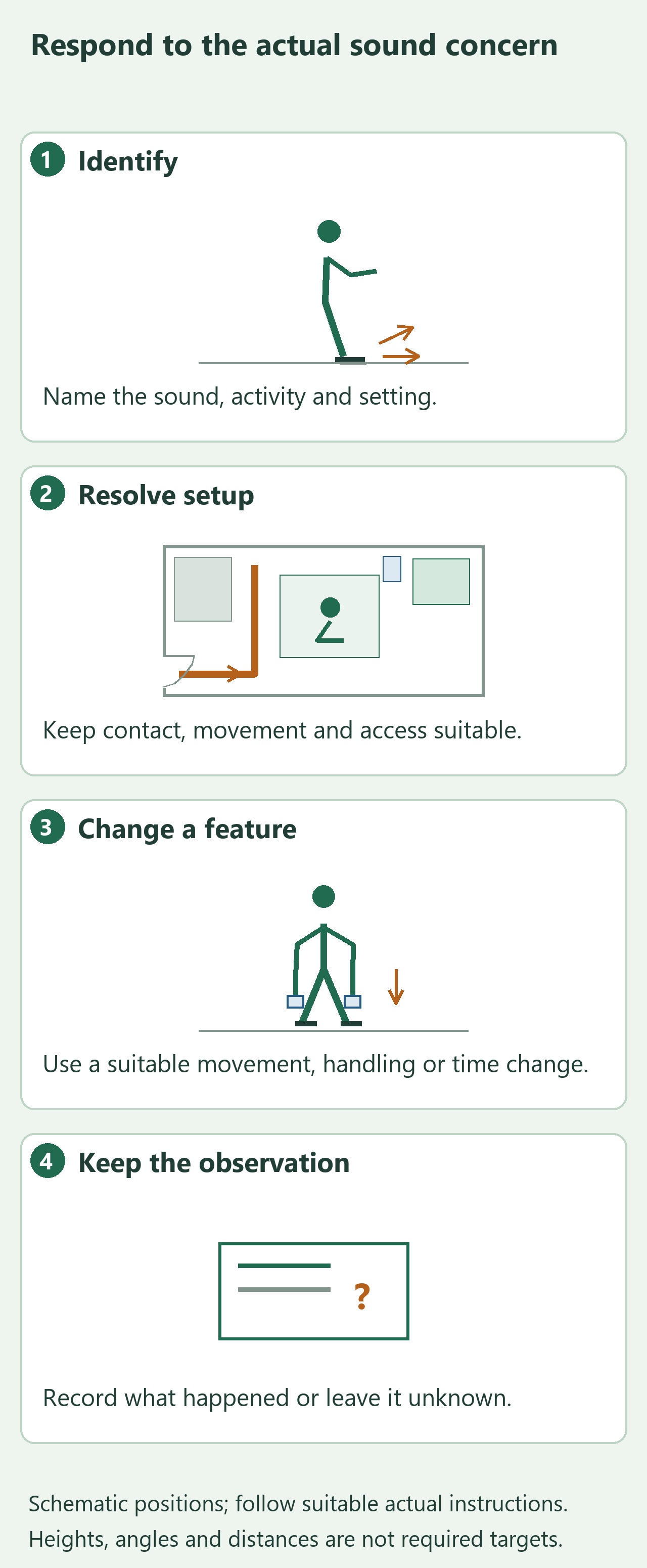
Respond to the actual sound concern
Examples to work through
These fictional examples illustrate practical choices and observations.
The mat slips during a quiet movement
Sara’s familiar march is not causing a sound complaint, but the mat moves underfoot. She pauses and resolves the surface or chooses another suitable setup. Quiet contact does not make a slipping surface acceptable.
The noise comes from putting down equipment
Owen identifies that the reported sound happens when he puts down a weight. He revises the load or handling arrangement he can manage with control, rather than changing a separate standing movement that was not the source of the problem.
A stepping option reaches the furniture
Nadia selects a no-jump stepping version, but its sideways path conflicts with a table. She resolves the path or chooses another suitable option and checks that setup. Turning the audio down would not address the obstacle.
The time changes but the sound is unobserved
Eli uses another suitable time for the same familiar activity. He records the scheduling change and leaves the transmitted-sound result unknown because it was not checked. A useful adjustment does not need an invented claim of silence.
Apartment movement, sound and setup note
Use these optional reminders to mark fields you want to keep in your own notes. The downloadable blank sheet contains every record field. Keep your completed record in your own appropriate private place.
Frequently asked questions
Does no-jump exercise mean no downstairs noise?
No-jump removes an airborne jumping phase, but standing steps and equipment contact may still be audible. Check the actual movement, floor and shared setting. The label does not measure transmitted sound or establish effort.
Which mat will make my apartment workout silent?
This guide does not test or rank mats and cannot promise silence. Any mat must also provide suitable contact without sliding or creating edge problems. Use product instructions and resolve the actual sound and surface concerns separately.
Should I move to seated exercise to be quieter?
A suitable seated option may change repeated foot contact, but it is a different exercise task. Establish the chair and movement requirements and your own suitability. Do not turn quietness into approval for a chair, floor transition or unfamiliar exercise.
What is the most useful thing to record?
Write the actual sound concern, movement, location, time and one change you made. Include whether the response was observed or remains unknown. Keep surface, space and symptom issues separate from that sound note.
Sources and what they support
- NHS: Strength exercises
Stable chair and seated fit; sit-to-stand, supported calf raise and wall press-up descriptions, example counts and gradual build-up.
- NHS: Sitting exercises
Stable chair, seated fit and the upright single-leg hip march. Use its own movement instructions and suitability guidance.
- NHS: How to warm up before exercising
The specific standing warm-up takes at least six minutes and can be longer. The accompanying general exercise advice includes stopping for pain or becoming unwell and obtaining appropriate guidance when suitability is uncertain.
The diagrams, fictional cases, records and combined session calendars are original educational aids. The listed sources inform the specific guidance described above; they do not prescribe every example timing or assess your individual situation.